Book Appointment Now
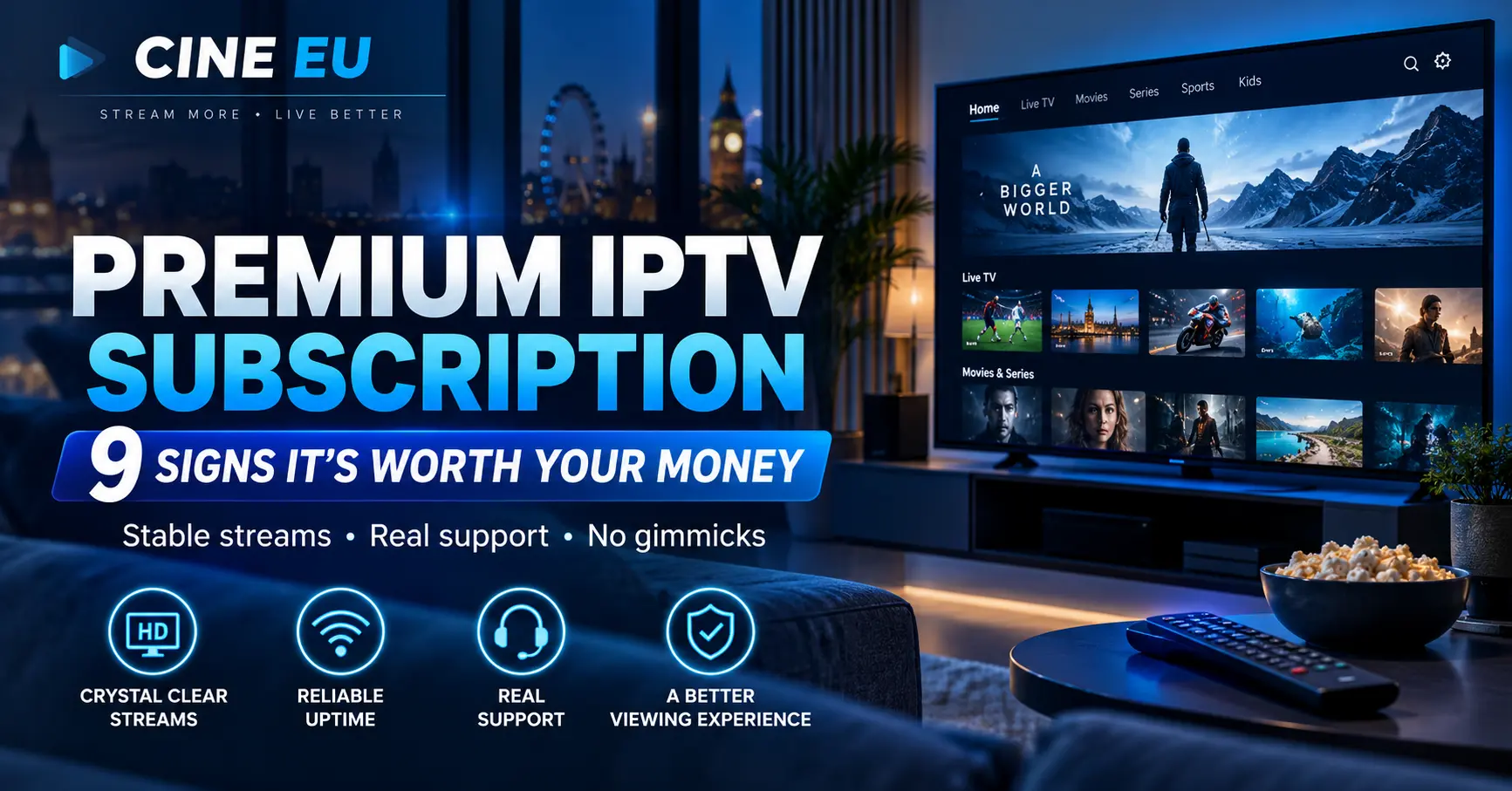
Stable Streams, Real Support, No Gimmicks: Finding a Premium IPTV Subscription That Lasts
Most people who ask me about a premium IPTV subscription are really asking a simpler question: am I about to waste my money? Fair enough. After fifteen years writing about broadband, set-top boxes and the slow decline of the satellite dish, I’ve learned that “premium” is the cheapest word in the streaming business. Anyone can type it onto a checkout page.
So here’s the short answer before we go any further. A genuinely premium service is worth paying for when it gives you stable streams at peak hours, a working programme guide, honest support and a provider who’ll still be around in six months. If it can’t prove those four things, it isn’t premium, whatever the banner says.
What “Premium” Should Actually Mean in 2026
Think about the last time a stream froze at the exact moment something mattered. That frustration is what you’re really paying to avoid. A premium IPTV subscription isn’t about having the longest channel list; it’s about the channels you actually use working every single time.
Honestly, channel counts have become a bit of a joke. I’ve tested services boasting 20,000 channels where half the categories were empty placeholders and the rest buffered like it was 2009. Quantity is easy to fake. Consistency isn’t.
Ofcom’s Media Nations reports have spent years documenting how British households are shifting their viewing towards streaming and away from traditional broadcast. That shift has created enormous demand, and demand attracts opportunists. The job of a smart buyer is to separate the properly engineered services from the ones held together with tape.
Consider what you’re actually replacing, too. For many households, an IPTV plan sits alongside or in place of a pricey satellite or cable package, and the maths only works if the experience is at least as dependable. Nobody wants to explain to the family why the screen has gone black halfway through the evening film.
Real premium, in my book, comes down to infrastructure, transparency and support. Everything else is marketing. The nine signs below are the checks I run personally before I’ll recommend any service to a reader, a friend or a family member.
The 9 Proven Signs of a Premium IPTV Subscription
None of these signs works in isolation. A provider might tick six boxes and fail badly on the other three, so treat this as a scorecard rather than a simple pass or fail test.
1. Streams Hold Up When Everyone Is Watching
Peak time is the only test that really counts. A service can look flawless at eleven on a Tuesday morning and fall apart at eight on a Saturday night when every household on the server is watching the same match. Ask for a trial that covers a weekend evening, not a quiet weekday.
Load-balanced servers and multiple backup sources are what keep a premium IPTV subscription steady under pressure. You won’t see this infrastructure, but you’ll feel its absence immediately.
2. The EPG Actually Matches What’s On
Electronic programme guides are the quiet backbone of a good viewing experience. When the guide is wrong or missing, you’re scrolling blind, and apps like TiviMate lose half their charm. I always check that listings line up with what’s actually playing across several categories, including regional ones.
Anyone curious about how guides are sourced and mapped will find more inhow EPG works on IPTV.
3. Clear Device and App Compatibility
Good providers tell you exactly which devices and apps they support. Amazon Firestick, Android TV boxes, MAG devices, smart TVs running IPTV Smarters Pro, iPhones and laptops should all be covered with proper setup guides. Vague answers like “works on everything” usually mean nobody has tested anything.
Setup guides matter more than people think. A clear walkthrough for entering an M3U link or Xtream Codes login saves you an hour of frustration. It also tells you the provider expects long-term customers rather than one-off sales.
4. Support That Replies Like a Human
Send a pre-sales question before you pay. Make it specific, like whether multi-room connections share one login or need separate lines. The speed and quality of the reply tells you almost everything about the aftercare that comes with your premium IPTV subscription.
Frankly, I’d take a smaller provider with a responsive WhatsApp or ticket desk over a slick website that goes silent the moment you’ve paid.
5. Honest Pricing Without Lifetime Promises
Lifetime deals are the biggest red flag in this market. Servers cost money every month, so a one-off payment for permanent access is very unlikely to last. A premium IPTV subscription should be priced monthly, quarterly or annually, with longer plans offering a sensible discount rather than a miracle.
6. A Trial That Isn’t a Trap
Short trials of 24 to 48 hours are standard. What matters is whether the trial gives you the real service or a stripped-back demo. If the trial line mysteriously outperforms your paid premium IPTV subscription later, you’ll know which one was staged.
Watch the trial like a critic rather than a fan. Flick between categories, open the catch-up section, try a film from the VOD library and leave a live channel running for an hour to see whether it drifts or drops.
7. Stable, Documented Connection Rules
Connection limits should be written down plainly. How many screens can stream at once? What happens if a family member opens a second device? Providers that explain this upfront are usually the same ones that don’t randomly lock your account.
8. Transparency About Who Runs the Service
Behind every subscription is an IPTV service provider running the servers, and often a reseller handling the customer relationship. Neither arrangement is a problem on its own. What bothers me is when nobody will tell you who to contact, where the business is registered or how refunds work.
9. Responsible Content Practices
Legality isn’t a footnote. Which? has repeatedly warned consumers about the security and legal risks attached to illicit streaming devices, and those warnings deserve to be taken seriously. A premium IPTV subscription from a reputable operator should be clear about how its content is sourced, and you remain responsible for what you watch in your own country.
How an IPTV Service Provider Builds What You Watch
Very few subscribers ever see the machinery behind their service, but understanding it makes you a far sharper buyer. Here’s the chain in its simplest form.
- The IPTV service provider operates the servers, content ingestion, transcoding and the Xtream Codes API or M3U delivery that your app connects to.
- Resellers buy IPTV credits in bulk through a reseller panel, usually at a discount that rewards volume.
- Each credit converts into subscription time, typically one credit for one month on one connection, though the ratio varies between panels.
- The reseller creates your line, sets your connection limit and handles your support queries.
- Your app, whether TiviMate, IPTV Smarters Pro or a MAG portal, pulls streams and the EPG from the provider’s infrastructure.
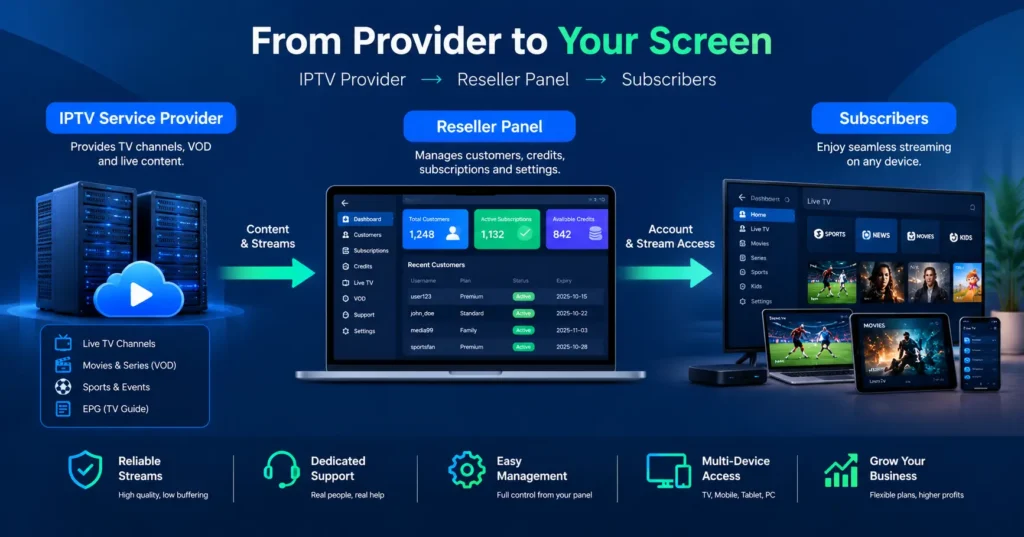
Why does this matter to you as a viewer? Because the quality of your premium IPTV subscription depends on both links in that chain. A brilliant server behind a careless reseller still means slow replies and misconfigured accounts. Equally, a friendly reseller can’t fix a server that collapses at peak.
IPTV credits also explain why prices vary so much between sellers offering what looks like the same service. A reseller who bought a large credit bundle can undercut one who bought ten credits at a time. Neither price tells you much about quality on its own.
If you’ve ever wondered whether you could run the reseller side yourself, I’ve written a separate walkthrough:
Buy IPTV Reseller Panel: UK, USA & Europe Guide (7 Proven Tips) → / buy iptv reseller panel. It covers panel selection, credit management and the regional differences that catch newcomers out.
A Quick Word on Credit Ratios
Credit ratios are worth a moment’s attention if you’re buying from a reseller. Some panels charge one credit per month, others bundle twelve months for ten credits, and multi-connection lines can consume two or three credits at once. When a reseller explains exactly how many IPTV credits your plan uses, it’s usually a sign they run a tidy operation.
Price Versus Promise: What You Really Get
Numbers help, so here’s how I’d broadly compare the tiers you’ll see advertised. These are typical patterns I’ve observed across UK and European sellers, not fixed rules, and exceptional services exist at every level.
| Feature | Budget Service | Mid-Range Service | Premium Service |
|---|---|---|---|
| Typical monthly cost | Under £5 | £6 to £10 | £10 to £18 |
| Peak-time stability | Often unstable | Mostly reliable | Consistently stable |
| EPG accuracy | Patchy or missing | Good on main categories | Accurate and regularly updated |
| Catch-up and VOD | Limited | Partial | Broad and well organised |
| Support response | Slow or none | Within a day | Usually within hours |
| Backup servers | Rarely | Sometimes | Standard |
| Trial offered | Occasionally | Usually | Almost always |
Looking at that table, you might assume the answer is always to pay more. It isn’t. The middle tier is genuinely good enough for plenty of households, and a premium IPTV subscription only earns its higher price if you’ll actually use the extra stability and depth.
The Hidden Cost of Going Cheap
Last winter, a neighbour of mine in the Midlands signed up for a £3 a month deal he’d found through a social media advert. It worked beautifully for eleven days. Then the server vanished, the seller’s page disappeared, and he’d lost a year’s payment along with the hours he’d spent setting up his Firestick.
He then paid for a proper premium IPTV subscription from a provider with a real support desk, and the difference was immediate. Same device, same broadband, completely different evening. The cheap option ended up costing him twice.
When a Premium IPTV Subscription Isn’t the Right Call
Here’s the part most reviews leave out. Premium isn’t automatically the right choice, and I’d be doing you a disservice if I pretended otherwise.
Broadband speed is the first limit. If your connection struggles to hold 25 Mbps in the evening, even the best server can’t fix what happens between your router and your telly. Run a check on Speedtest by Ookla at peak time before blaming any provider, and consider a wired Ethernet connection for your main screen.
Light viewers are the second group. Someone who watches a handful of programmes a week may be perfectly well served by free-to-air apps and one official streaming platform. Paying for a premium IPTV subscription you barely open is the opposite of good value.
Families with young children should also weigh parental controls carefully. Not every app offers robust PIN locks for adult categories, and some providers bundle those categories in by default. Check before you commit, not after.
Travel is the final wrinkle. Some services restrict usage by region or block logins from new IP addresses, which can be a nuisance if you split time between two countries. Ask about this directly, especially if you’ll be watching from both the UK and abroad.
Nothing here is meant to put you off. It’s simply that the best purchase is the one that fits how you actually watch. Sometimes that’s a smaller, cheaper plan, and occasionally it’s no plan at all.
My Pre-Purchase Checklist for Subscribers
Before handing over a card number, I run through this list. It takes about ten minutes and has saved me from more than one bad decision.
- Test the trial on a Friday or Saturday evening, not a quiet weekday morning
- Confirm your broadband holds a steady speed at peak time on a wired connection
- Check the EPG against what’s actually airing in three or four categories
- Ask support a specific question and time the reply
- Get the connection limit and device rules confirmed in writing
- Avoid any lifetime or “unlimited forever” offer
- Find out who the IPTV service provider or reseller is and how refunds work
- Start on a monthly plan before committing to twelve months
Once a premium IPTV subscription passes all eight checks, a longer plan usually makes financial sense. Until then, monthly is your friend, even if it costs a few pounds more.
A Final Word Before You Subscribe
What would I tell a friend over a pint? Pay for reliability, not for numbers. A premium IPTV subscription earns its name at peak time, in the support inbox and six months down the line, not on the sales page.
Take the trial seriously, ask awkward questions and walk away from anything that sounds too generous to be real. The good providers won’t mind the scrutiny. They’ll welcome it, because it’s the careless ones that give the whole industry its reputation.
Choose carefully, and you’ll wonder why you ever put up with buffering in the first place.
Frequently Asked Questions
What is a premium IPTV subscription?
Essentially, it’s an internet-delivered TV service that prioritises stable streams, accurate programme guides, catch-up content and responsive support. The “premium” label should reflect genuine infrastructure such as load-balanced and backup servers. Price alone doesn’t make a service premium. Always judge it on peak-time performance during a trial.
How much should a premium IPTV subscription cost in the UK?
Typically, you’ll see premium plans between £10 and £18 a month, with discounts for quarterly or annual payments. Anything drastically below that range deserves extra scrutiny, particularly if it comes with a lifetime promise. Higher prices don’t guarantee quality either. Use the trial period to confirm the service matches its price.
What are IPTV credits and do subscribers need them?
Resellers use IPTV credits to create and renew subscriber accounts through a panel, with each credit usually representing one month on one connection. As a viewer, you never need to buy credits yourself. Your reseller handles that in the background when you pay for your plan. Understanding credits simply helps explain why prices differ between sellers.
How do I know if an IPTV service provider is trustworthy?
Start by sending a detailed pre-sales question and noting how quickly and clearly they respond. A trustworthy provider explains connection limits, device support and refund terms without dodging. Avoid anyone offering lifetime access or refusing to say who runs the service. A short trial at peak time will reveal the rest.
Can I use one subscription on several devices?
Usually yes, but only within the connection limit on your plan. Most standard plans allow one active stream at a time, while multi-connection plans let two or more screens play simultaneously. Logging in on extra devices beyond your limit can trigger temporary blocks. Confirm the rules in writing before you add family members.