Book Appointment Now
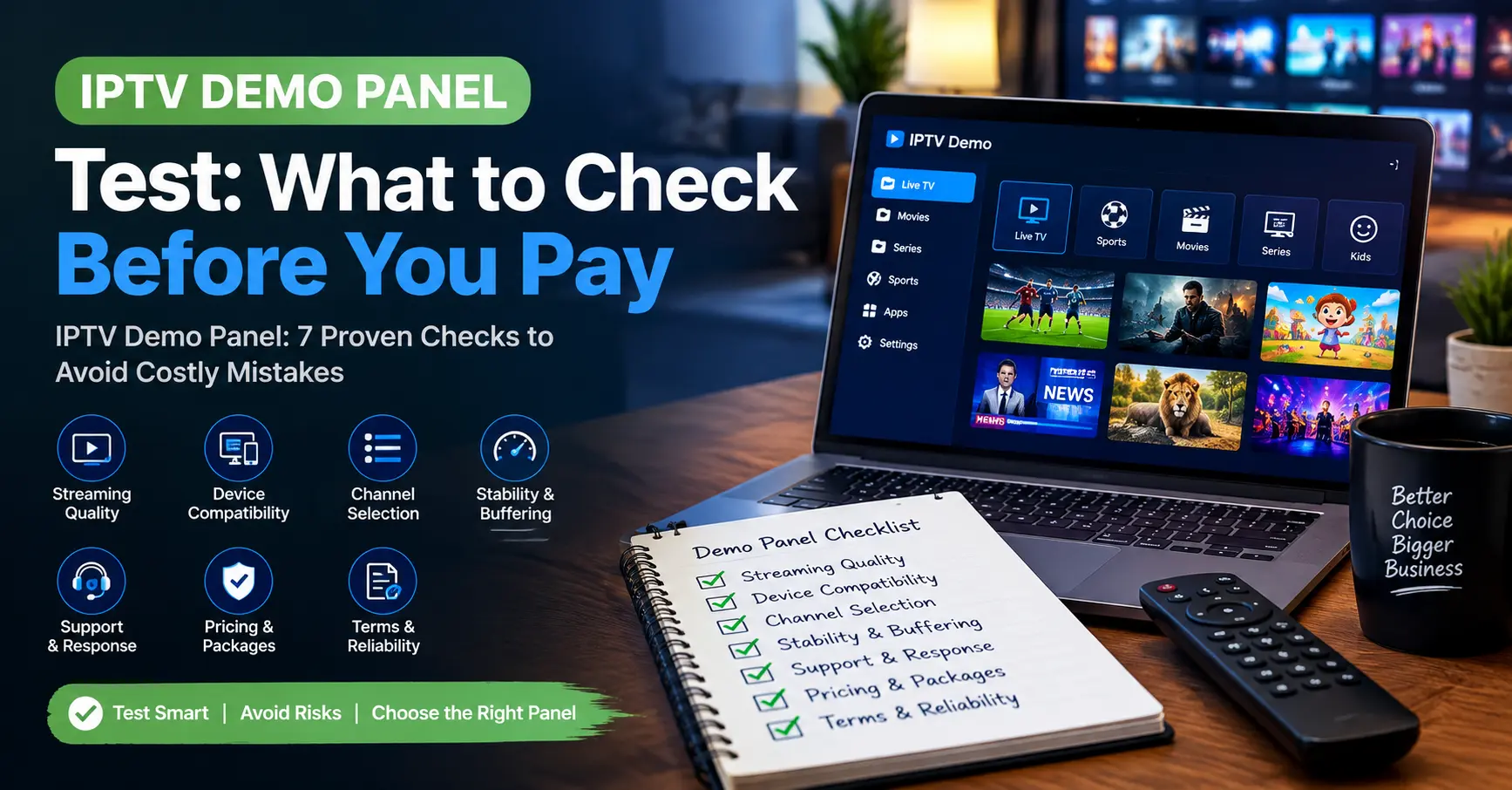
The IPTV Demo Panel Test: What to Check Before You Pay
Picture this. You’ve spent forty minutes comparing packages, you’ve read three glowing reviews, and the sales page promises crystal clear football on every device you own. Then you pay, log in, and the picture freezes during the first big match. That sinking feeling is exactly why an iptv demo panel exists.
I’ve been writing about streaming and telecoms for years, and I’ve watched people repeat the same costly mistake. A proper iptv demo panel gives you a safe look at the service before a single pound leaves your account. Used well, it tells you more than any review ever could.
This guide walks through what a demo should contain, how to test it, and what to do with the results. It’s written for ordinary viewers, but I’ve also included a section for anyone thinking of becoming an iptv reseller. Whichever camp you’re in, you’ll leave with a clear checklist.
Why an IPTV Demo Panel Beats Any Sales Page
Sales pages are written to convince, not to inform. Every provider shows sharp screenshots, long channel lists and a confident promise about uptime. None of that proves the stream will hold up on your broadband at eight o’clock on a Saturday evening.
Anyone can claim to offer the best iptv experience in the country. Only a live test shows whether the claim survives contact with your own router, your own television and your own habits. That’s the whole value of a demo.
Think of it like a test drive. You wouldn’t buy a car because the brochure looked good, and you shouldn’t commit to a premium iptv service on the strength of a banner image. The demo is your twenty minutes behind the wheel.
Then there’s the matter of honesty. A provider who offers a demo openly is telling you they’re confident in what they run. One who refuses, or hides it behind endless forms, is telling you something too.
Here’s my honest view after years of testing services. An iptv demo panel won’t guarantee a perfect experience for twelve months, but it will filter out the worst offenders in minutes. That alone makes it worth your time.
What a Good Demo Actually Contains
The Basics You Should See
Most providers hand over an iptv demo panel as a login for a limited time, usually somewhere between a few hours and a couple of days. You’ll typically get a small selection of channels, a sample of on-demand titles and a basic programme guide. That’s enough to judge the fundamentals.
Look for a real app or interface rather than a screenshot. On a decent iptv demo panel you should be able to browse categories, search for titles and open the electronic programme guide. If you can’t touch it, it isn’t a demo.
What a Demo Can’t Tell You
Of course, a demo has limits. It can’t show how the service copes when thousands of people are watching the same final at once. It can’t predict how support behaves three months later when you’ve got a billing question.
Some providers also give their iptv demo panel extra server capacity, which flatters the result. I’ve seen this happen, and it’s a fair trade-off to keep in mind. Treat the demo as a strong signal, not a promise.
Seven Checks I Run Every Single Time
Over the years I’ve settled on a routine for testing any iptv demo panel, and it takes about an hour. It isn’t scientific, but it catches nearly every problem I care about. Here’s the list, in the order I do it.
- Check the signup friction. A reputable iptv provider should give you access quickly and without asking for card details. If the demo needs a payment method, stop right there.
- Test at peak time. Log in on an evening or weekend, when networks are busiest. A stream that’s smooth at ten in the morning proves very little.
- Switch channels fast. Flick through twenty channels in a row and note how long each takes to load. Anything over a few seconds is a warning sign.
- Watch live sport. Fast motion exposes weak encoding and poor bitrates faster than any drama will.
- Try more than one device. Test your television, your phone and, if you can, a streaming stick. Apps behave differently on each.
- Look at the programme guide. Is it accurate, complete and correctly timed? A broken guide usually means a careless operation.
- Message support. Ask a simple question and time the reply. You’re testing the people as much as the platform.
You can measure your own connection first with Speedtest by Ookla, which gives a quick read on download speed and latency. Ofcom’s broadband research has also shown that real-world speeds often fall short of advertised headline figures. Knowing your baseline stops you blaming the stream for a problem that lives in your hallway.
Notice that none of these checks need technical expertise. They need patience and a notepad. I’d write down a score for each one, because by day two your memory will have rounded everything up.
How I Score the Results
Scoring keeps me honest. I give each of the seven checks a mark from one to ten, then add them up. Anything below fifty goes straight in the bin, and anything above sixty earns a paid short trial.
Weighting matters a little too. Stream stability counts double in my head, because a lovely guide won’t rescue a service that freezes. Support speed comes next, since you’ll need it eventually.
Different households care about different things, of course. If you’ve got children, parental controls and tidy categories might matter more than raw channel count. If you’re a sports fan, picture quality and delay are everything.
A Demo Session From First Login to Final Verdict
Minute one is boring, and that’s fine. You log in, wait for the app to load and check that the interface looks like something a human designed. Slow loading at this point is the first small clue.
Around minute ten I start flicking through categories. I’m looking at logos, channel names and whether the guide matches what’s actually on air. Messy naming, duplicate channels and dead links tell me a lot about how carefully the library is maintained.
Half an hour in, I pick a live match or a news channel and just watch. I’m not hunting for faults, I’m noticing whether I forget I’m testing anything. If I catch myself leaning forward to check for lag, that’s a bad sign.
Later in the evening I come back and repeat a shorter version. Peak time is when weak servers show their true colours, and one bad night is worth ten good reviews. Have you ever noticed how a stream that’s perfect at lunchtime can wobble at nine o’clock?
Finally, I write a two-line verdict while it’s fresh. One line says what impressed me, the other says what worried me. When I compare providers a week later, those notes are worth more than my memory.
Demo, Trial or Test Line? A Quick Comparison
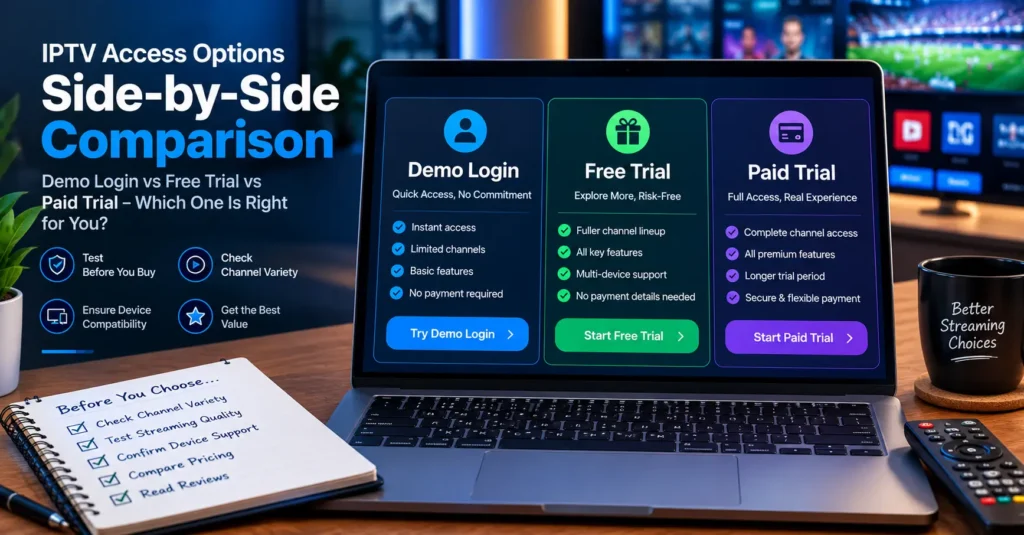
Terminology is slippery in this industry. Some sellers say demo, others say trial or test line, and they don’t always mean the same thing. This table shows how I tend to think about them.
| Type | Typical length | Usually includes | Best for |
|---|---|---|---|
| Demo panel login | A few hours to 2 days | Limited channels, sample on-demand titles, guide | Judging the interface and basic stability |
| Free trial | 24 to 72 hours | Full channel list on one device | Testing peak-time performance |
| Paid short trial | 7 days to 1 month | Everything, often at a low cost | Final decision before a long plan |
None of these is automatically better. A short iptv demo panel is quick but shallow, while a paid month costs money but tells you the truth. I usually start with the first, then pay for a short term before committing to a year.
How an IPTV Demo Panel Protects a Reseller’s Reputation
Everything above applies to viewers, but there’s a second audience I want to talk to. If you’re thinking of becoming an iptv reseller, you’ll be putting your name in front of customers who expect things to work. A weak supplier can sink your reputation in a week.
That’s where an iptv demo panel becomes a business tool rather than a curiosity. Before you buy credits from any supplier, you can test what your own customers would experience. If it buffers for you, it’ll do exactly the same for them.
Ask the supplier for two things: an iptv demo panel login and a look at the reseller dashboard. You want to see how accounts are created, how renewals work and how quickly you can fix a customer’s problem. A tidy panel usually reflects a tidy operation. choosing a trustworthy iptv reseller covers the wider supplier checklist.
Quite often the supplier with the flashiest marketing has the messiest backend. I’ve seen dashboards where creating a single customer took six clicks and a page refresh. Multiply that by fifty customers and you’ll understand why I pay attention.
Margins tempt a lot of newcomers. Cheap credits look wonderful on a spreadsheet, but support costs, refunds and churn eat into the profit quickly. A reliable supplier at a slightly higher price almost always wins over a year.
Would you put your own name on a service that stalls at halftime? That’s the question I ask before I recommend any supplier to a new iptv reseller. If the honest answer is no, the discount isn’t worth it.
Customers rarely complain politely. They message at ten at night, they cancel without warning, and they tell their friends. The demo is your best chance to hear that criticism before it’s aimed at you.
There’s also the legal side, which no reseller should shrug off. Make sure your supplier can explain where its content is licensed from, and keep that paperwork. The Intellectual Property Office and the anti-piracy body FACT both publish guidance on unlicensed streaming, and it’s worth reading before you sign anything.
Red Flags That Should Make You Walk Away
Last winter a friend of mine in Manchester ran a small reseller business on the side, and he nearly bought a year of credits from a supplier he found in a forum. The demo he’d been given ran beautifully for two hours, then collapsed during a Sunday match. He walked away, and he’s still grateful he tested it that way.
Here are the warning signs I’d treat as deal breakers:
- A demo that only works at odd hours or on one specific device.
- Pressure to pay immediately because a discount “ends tonight”.
- No named company, no registered address and no way to reach a human.
- Payment only by methods you can’t dispute, such as crypto or gift cards.
- Vague answers about licensing when you ask directly.
Which? has repeatedly warned consumers about the risks tied to dodgy streaming setups, from poor reliability to payment fraud. That’s not a reason to avoid every service. It’s a reason to ask better questions before you pay.
Testing Safely: Payments, Privacy and Common Sense
Never hand over more information than a demo needs. An email address is plenty, and a legitimate iptv provider won’t ask for your full address or card number at this stage. If a form feels like a data grab, close the tab.
Use a separate email for trials if you like. It keeps your main inbox free from the follow-up messages that nearly every provider sends. It also gives you a tidy record of what each provider promised.
When it’s time to pay, choose a method that offers some protection, such as a credit card or a recognized payment service. Your bank’s dispute process can help if a seller disappears, and it’s far harder to use if you’ve paid by transfer or gift card. It’s a boring tip that has saved plenty of people real money.
Equally, read the terms. Look at refund policies, renewal rules and what happens if channels are removed. A provider with clear terms is a provider who expects to be held to them.
Reading the Provider Behind the Screen
Reputation Beyond the Demo
Once the demo checks out, spend ten minutes on the company itself. Search for the business name, look for independent reviews and read the complaints as carefully as the praise. Every iptv provider collects a few unhappy customers, so you’re looking for patterns rather than single rants.
Trustpilot is a reasonable starting point, though I’d never rely on it alone. Fake reviews exist everywhere, so I look for detailed, specific comments and sensible replies from the owner. A company that answers criticism calmly usually behaves well when problems arise.
What Premium Should Actually Mean
Marketing loves the word premium. A genuine premium iptv service should mean stable streams, sensible pricing, clear terms and support that replies the same day. If the only premium thing about it is the price, keep looking. what a premium iptv service should include goes into more detail on this.
Likewise, treat the phrase best iptv with healthy suspicion. There’s no single best option for everyone, because the right service depends on your region, your devices and the channels you actually watch. The best iptv for a family in Glasgow may be a poor fit for an expat in Dubai.
A Sensible Next Step
So here’s what I’d do this week. Pick two providers, request an iptv demo panel from each and run the seven checks side by side. Score them honestly, then decide.
Resellers should add one more step: ask for the demo login and the dashboard together, then test on a friend’s connection too. Two different networks tell you far more than one.
Streaming should feel dull in the best possible way. No buffering, no drama, no emails to support at halftime. Go and ask for that demo today, and your future self will thank you for the twenty minutes.
Frequently Asked Questions
Q: What is an iptv demo panel and how does it work?
A: It’s a temporary, limited login that lets you test a service before paying. You usually receive a username and password, or a short activation link, for a small selection of channels and titles. The provider may restrict the duration, the number of devices or the content on offer. Think of it as a sample, not the full product.
Q: How long should an iptv demo panel last?
A: Usually between a few hours and two days. That’s long enough to test peak-time performance if you plan your evening around it. Anything shorter than an hour is too brief to judge. If the provider offers more, take it and run your checks across two separate evenings.
Q: Is a free demo enough to choose the best iptv provider?
A: Not on its own. A demo shows you the interface and basic stability, but it can’t show how the service handles a busy final or a billing dispute. Pair it with independent reviews, clear terms and a short paid trial. Once all three line up, you can commit with far more confidence.
Q: Can an iptv reseller use a demo to test a supplier?
A: Absolutely, and they should. Ask for an iptv demo panel login alongside a preview of the reseller dashboard, then test both properly. Check how fast accounts are created and how support responds to an awkward question. A supplier who hesitates at this stage will hesitate when your customers complain.
Q: What makes a premium iptv service worth paying for?
A: Reliability comes first, followed by clear terms and responsive support. A premium iptv service should be able to prove its licensing, explain pricing plainly and fix faults quickly. It shouldn’t rely on countdown timers or pressure tactics. If the price is high but those basics are missing, you’re simply paying for marketing.
[…] If you’re weighing that step, read The IPTV Demo Panel Test: What to Check Before You Pay → /iptv demo panel test first, because a trial is the cheapest way to test your own iptv connection uk against their […]