Book Appointment Now
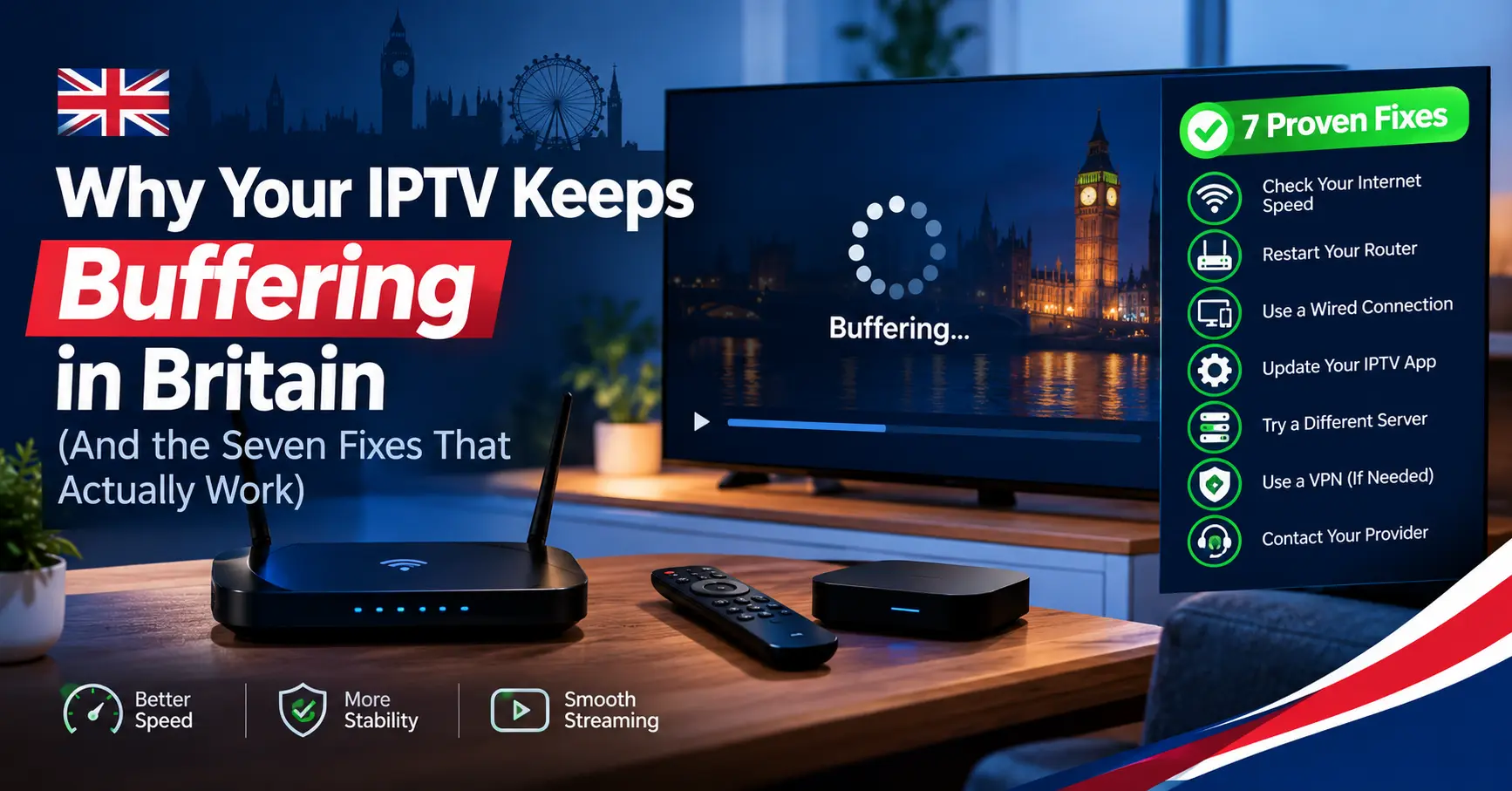
Why Your IPTV Keeps Buffering in Britain (And the Seven Fixes That Actually Work)
It was 8:55 on a Saturday night, and my brother-in-law had five people in his lounge waiting for a big fight card to start. The picture froze, then pixelated, then vanished behind a spinning wheel. He blamed the app, then the box, then me.
I’ve heard that story, in different costumes, more times than I can count. Nine times out of ten the culprit isn’t the app or the box. It’s the whole chain that makes up an iptv connection uk viewers depend on, from the router in the hallway to the server at the far end.
This guide walks through that chain link by link. You’ll get real speed targets, free router fixes and some straight talk about what a supplier can and can’t control. I’ll also explain how an iptv reseller works, what an iptv panel actually does, and how to judge the best iptv provider for your own situation. Fair warning: I’ve tested most of this at home, and a few of my experiments went badly.
What Actually Happens When a Stream Freezes
Picture a relay race. Your provider’s server hands a chunk of video to the internet, the internet passes it through several networks, and your router carries it the last few metres to your TV. If any runner stumbles, the picture stalls.
Buffering is simply your player running out of runway. It keeps a small cache of video, usually a few seconds’ worth, and when fresh data arrives too slowly that cache empties. Hence the spinning wheel you know and hate.
Three things cause most stalls on an iptv connection uk viewers rely on: not enough bandwidth, unstable delivery, or an overloaded server. Only the first two live inside your house. Knowing which one you’re facing saves hours of random button pressing.
So where should you start? With the one thing you can measure in under a minute.
Test Your IPTV Connection UK Speed Before Blaming Anyone
Run a speed test on a device wired to the router, using Ookla’s Speedtest or Netflix’s Fast.com. Do it twice, once in the afternoon and once between 7pm and 10pm. The gap between those two numbers tells you more than either one alone.
As a rough guide, a standard HD stream wants around 8 Mbps, and a 4K stream is happier with 25 Mbps or more. Those figures vary by provider and video codec, so treat them as starting points. Every extra screen in the house adds its own demand.
| What you’re doing | Suggested minimum | Comfortable target |
|---|---|---|
| One HD stream | 8 Mbps | 15 Mbps |
| One 4K stream | 25 Mbps | 40 Mbps |
| Two HD streams plus browsing | 20 Mbps | 35 Mbps |
| 4K plus family video calls | 50 Mbps | 80 Mbps |
Ofcom’s published broadband research has shown for years that real-world speeds often land below the headline figure on the box. Older copper-based lines are the usual offenders. If you’re on a long fibre-to-the-cabinet run, that gap can be brutal, and a speed test is the honest way to find out.
Pay attention to latency and consistency too, not just download speed. A ping above 60 ms, or wild swings between tests, often points to a shaky line or a busy router. When your iptv connection uk results look fine on paper yet the stream still stutters, jitter is the usual villain.
Many people stop at the headline number, which is a mistake. A test on your laptop in the study says little about the stick behind the living room TV. Run the check on the same Wi-Fi band and in the same spot where you actually watch.
Wi-Fi, Ethernet and the Router in the Corner
Last spring I spent a whole weekend fighting buffering on a Fire TV Stick. I updated the app, reset the stick and even bought a new HDMI cable. The real problem was a router tucked behind a fish tank, and water absorbs Wi-Fi signals far better than you’d expect.
Wired is king. A cheap Ethernet cable between router and streaming box removes the most common source of instability in one move. A tidy home network is the backbone of any iptv connection uk setup, and a cable is the cheapest upgrade in the whole hobby.
If you can’t run a cable, work through these:
- Use the 5GHz band for devices near the router, and keep 2.4GHz for distant rooms.
- Lift the router off the floor and away from microwaves, thick walls and fish tanks.
- Restart the router once a week, or schedule a 4am reboot if your hub allows it.
- Update the firmware, especially on ISP hubs such as the BT Smart Hub or Sky Hub.
- Check which channel your Wi-Fi uses, since crowded flats can make neighbours’ networks your enemy.
Which? has tested plenty of routers over the years, and its general message holds up. The free hub from your ISP is fine for a small flat and often mediocre for anything bigger. Still, don’t spend £300 before you’ve tried the free fixes.
Mesh systems deserve a fair hearing too. Kits such as TP-Link Deco or Netgear Orbi spread coverage across larger homes, though a cheap one can halve your speed at each hop. If your house allows wired backhaul between the mesh units, use it.
Peak Hours, ISPs and the British Evening Crunch
Between roughly 7pm and 11pm, everyone on your street is streaming, gaming or downloading at once. Shared infrastructure, particularly on cable networks, can slow noticeably during those hours. That’s why a stream that behaves at lunchtime can fall apart during the main event.
Some ISPs also use carrier-grade NAT, which shares one public address among many customers. It rarely breaks streaming, but it can upset certain apps. Ask your ISP whether you’re behind it, and whether a different arrangement is available.
DNS matters more than people think. Switching your router or streaming box to Cloudflare’s 1.1.1.1 or Google’s 8.8.8.8 can speed up channel loading and trim the lag at the start of each stream. It won’t create bandwidth from nothing, but it’s a free tweak for any iptv connection uk household.
A VPN is a mixed bag. Some viewers use one to dodge ISP throttling, and in a few cases it helps. More often it adds latency and cuts speed, so test with it on and off before you decide.
Here’s a mini-experiment I recommend. Watch the same channel at 6pm and 9pm for a week and jot down every stall. If the problems cluster after 8pm, your iptv connection uk is probably suffering from congestion, either at your ISP or at the provider’s server.
Reading the Symptoms: What Each Glitch Is Telling You
Not every stall looks the same, and the pattern is a clue. This table matches common symptoms with likely causes.
| Symptom | Likely cause | First thing to try |
|---|---|---|
| Freezes every few minutes, then recovers | Weak Wi-Fi or congestion | Switch to Ethernet |
| Blocky, pixelated picture | Dropped data or overloaded server | Ask for a server change |
| Long delay when changing channels | Slow DNS or weak device | Change DNS, clear app cache |
| Fine all day, awful at 9pm | Peak-time congestion | Log the times, test another DNS |
| Audio drops while video continues | App or decoder fault | Try a different player app |
Once you’ve matched the symptom, resist the urge to change everything at once. Change one setting, watch for a day, then move on. Otherwise you’ll never know what actually worked.
Where an IPTV Reseller and an IPTV Panel Fit In
Your home network is only half the story. The other half is whoever supplies the streams. Most subscribers deal with an iptv reseller, a middle layer who buys capacity from a larger supplier and sells it on to customers.
Behind the scenes, that reseller manages everyone through an iptv panel. Think of it as a control dashboard where lines are created, renewed, suspended and assigned to server groups. A good panel shows connection counts, expiry dates and which server each customer sits on.
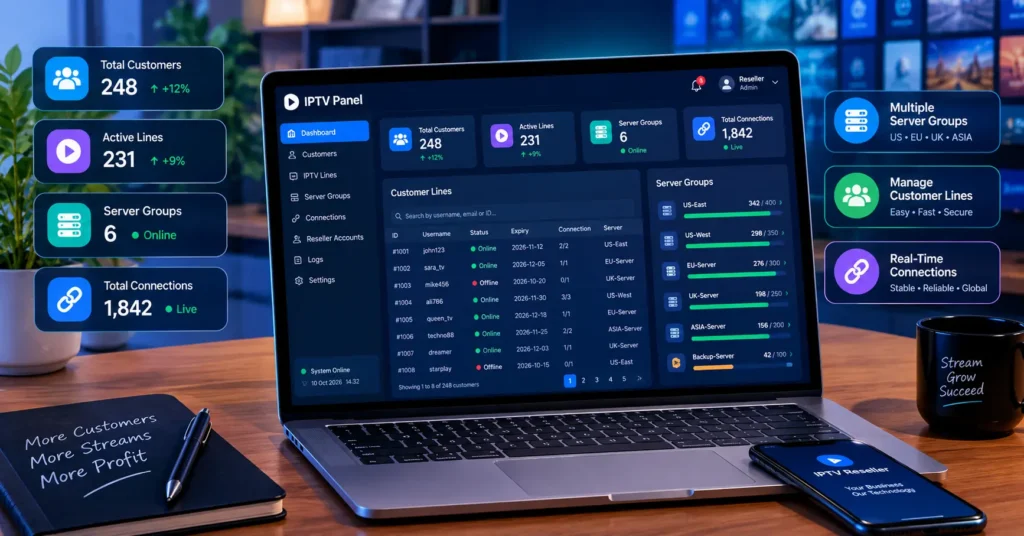
Why should you care? Because a reseller who crams too many lines onto one server can wreck your viewing even if your broadband is flawless. No amount of router tuning rescues an overloaded source.
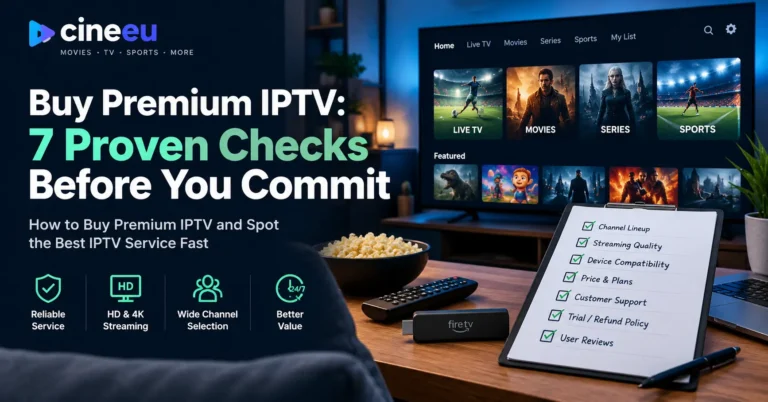
Reputable resellers will tell you plainly how many connections a line allows and which server regions they use. They’ll also offer a short trial before you commit. If you’re weighing that step, read The IPTV Demo Panel Test: What to Check Before You Pay → /iptv demo panel test first, because a trial is the cheapest way to test your own iptv connection uk against their service.
Capacity is the quiet issue nobody advertises. A server might handle 2,000 simultaneous streams smoothly and wobble at 3,000. Resellers rarely see that ceiling coming until a big fixture arrives, and by then your iptv connection uk gets blamed for a problem it didn’t cause.
Choosing the Best IPTV Provider Without Getting Burned
Nobody can honestly crown one universal best iptv provider, because the right choice depends on your location, devices and viewing habits. What you can do is score every candidate against the same checklist. It’s the closest thing to a fair fight.
- Licensing: Can they show where their content comes from?
- Trial: Is there a short test period before you pay in full?
- Support: Do real people answer within a day?
- Server transparency: Are UK or nearby European servers on offer?
- Device support: Does the service work with your box and a standard player app?
- Refund terms: Are they written down somewhere you can find them?
Notice that price isn’t on the list. Rock-bottom pricing usually means overselling, and overselling means buffering, which can sink even a strong iptv connection uk. I’d rather pay a little more and watch the match from start to finish.
Pre-sale questions reveal plenty. Ask what happens during a server outage and how long fixes usually take. If the answer is vague, or arrives three days later, take it as a preview of future support.
I’ll be upfront about a trade-off. Smaller providers often give warmer, faster support, while larger ones usually have more server capacity. Neither is automatically better, so let your own priorities decide.
Hardware That Helps and Hardware That Hurts
The streaming device does more work than you’d think. It decodes video, runs the app and manages Wi-Fi all at once. A weak box can look like a network problem when it’s really a processing problem.
Older sticks with 1GB of RAM struggle with 4K, while a Fire TV Stick 4K Max, an Nvidia Shield or a decent Formuler box copes far better. Smart TVs vary wildly. Some built-in apps are slick, and others are slow and prone to crashing.
Heat is the silent killer. Cheap boxes tucked behind a TV can throttle themselves when they get hot, and the stutter looks exactly like a flaky iptv connection uk. Give the device some breathing room and see whether things improve.
A Seven-Step Fix List for a Stable IPTV Connection UK Setup
Work through these in order, from cheapest to most involved. Stop the moment the stalling does.
Steps one to three: tidy up your own iptv connection uk
Step one is to plug the streaming box into the router with Ethernet. Step two is to reboot the router and move it somewhere open. Step three is to stop other devices hogging bandwidth, which means pausing cloud backups and big game downloads while you watch.
Steps four and five: tune the app and the box
Clear the app cache and update to the latest version, since outdated players are a surprisingly common cause of freezing. It takes two minutes and costs nothing.
Then try another player such as TiviMate or IPTV Smarters. Switching apps takes about ten minutes and tells you quickly whether the fault is software.
Steps six and seven: question the supplier
Ask your iptv reseller to move your line to a different server. If they use an iptv panel, it’s a thirty-second job on their side. Should the stalling vanish, you’ve found your culprit.
Seventh and last comes the hardest decision. If nothing improves after a server move and a clean test at home, consider another best iptv provider rather than blaming yourself. Loyalty is lovely, but not at the cost of every Saturday night.
A Quick Legal Reality Check
Licensing deserves a straight word. In the UK, streaming copyrighted channels from an unlicensed source is unlawful, and the Federation Against Copyright Theft actively pursues sellers. Buyers can face consequences too, and unlicensed services can vanish overnight along with your money.
Stick to services that can show a legitimate licence trail, or use the broadcasters’ own apps for premium sport and drama. If a price looks impossibly low for what’s on offer, ask yourself why. Your iptv connection uk can be perfect and the service still unreliable if the supply behind it isn’t legitimate.
The Last Word Before You Reboot
Good streaming is rarely about one magic setting. It’s a chain, and your job is to find the weak link rather than replace the whole thing. Start with a speed test tonight, run the cable tomorrow, and keep honest notes on your iptv connection uk all week.
Whether you’re talking to an iptv reseller, poking around an iptv panel or hunting for the best iptv provider, the same rule applies: trust what you can test. Do that, and your next big match night should end with cheering rather than swearing. Go on, plug that cable in.
Frequently Asked Questions
Q1: What speed do I need for a reliable iptv connection uk setup?
A: For one HD stream, aim for at least 8 Mbps, and ideally 15 Mbps to leave some headroom. A single 4K stream is more comfortable at 25 Mbps or above. Add the demand from every other device in the house, since phones, laptops and consoles compete for the same pipe. Always test at peak time, because evening speeds can differ a lot from daytime results.
Q2: Why does my IPTV buffer only in the evening?
A: Evening is when neighbourhood networks are busiest, particularly on shared cable infrastructure. The provider’s servers also see their highest load then, so congestion can happen at either end. Keep a log for a week and note the times of each stall. If the problems cluster after 8pm, try Ethernet, a different DNS and a server change before you give up.
Q3: Is Wi-Fi good enough for IPTV, or do I need Ethernet?
A: Good 5GHz Wi-Fi works fine in many homes, especially with the streaming box in the same room as the router. Ethernet is still more stable because it avoids interference and signal drops. If you can’t run a cable, powerline adapters or a quality mesh system are sensible alternatives. Test whichever option you choose during the evening peak.
Q4: How can I tell whether my iptv connection uk problem is my broadband or my provider?
A: Play something from BBC iPlayer or Netflix at the same moment the IPTV stalls. If those run perfectly, your broadband is probably fine and the supplier is the likelier cause. If everything struggles, look at your router, Wi-Fi and ISP first. Asking your reseller to move you to another server is a quick extra check.
Q5: What should I ask an IPTV reseller before paying?
A: Ask how many connections the line includes, which server regions are used and how long a trial lasts. Find out how support works and how quickly they usually reply. Request written refund terms, and ask where the content is licensed from. A reseller who answers clearly and promptly is usually worth a closer look.

[…] reading Why Your IPTV Keeps Buffering in Britain (And the Seven Fixes That Actually Work) → /why your iptv keeps buffering in britain before you blame the supplier outright. Sometimes the culprit is a tired home router or a crowded […]