Book Appointment Now
Best IPTV Ireland 2026: Top Providers & Channels
Best IPTV Ireland 2026 comparisons are everywhere, but most of them skip the one question that actually decides whether a service is worth your money: can the provider show where its content rights come from. That single check separates a service that will still be working in six months from one that might vanish overnight, taking your subscription with it. The rest comes down to practical details: device compatibility, honest pricing, how support behaves when something breaks, and how the provider is positioned given Ireland’s increasingly active enforcement environment around unlicensed streaming.
Best IPTV Ireland 2026: The Short Answer

There isn’t a single “best” provider that suits everyone, because household needs differ too much for one answer to hold. What does hold across every household is a shortlist of checks worth running before you pay anyone:
- The provider can explain, in plain terms, how its content is licensed
- Pricing is quoted upfront in euro, with no vague “contact us for pricing” tactics
- The app or box works on the devices you already own, not just the ones they’d prefer to sell you
- Support responds during the hours you’d actually need it, particularly during live sport
- There’s a genuine trial or short-term option before you commit to a longer plan
If a service passes all five, it’s a realistic contender. If it fails even one, that’s usually enough reason to keep looking rather than assume the rest will work out.
Why the Irish IPTV Market Isn’t What It Was Two Years Ago
Ireland’s approach to unlicensed streaming has shifted noticeably. Courts have granted blocking orders against internet providers, requiring them to disrupt access to servers hosting unlicensed sport and entertainment during live broadcasts. Separately, a major broadcaster secured a High Court order compelling a payment platform to hand over subscriber and UK IPTV Panel reseller details linked to an unlicensed service, and cease-and-desist notices followed for both operators and paying customers. None of this means IPTV itself is in legal trouble. IPTV is simply a delivery method, the same one used by licensed streaming apps and catch-up services. The legal exposure sits specifically with services distributing copyrighted content, particularly live sport, without the rights to do so.
Two practical consequences follow from this. First, ISP-level blocking during live matches means a provider relying on unlicensed feeds may simply go dark at the exact moment you want it working. Second, payment traceability has become a live issue in Ireland, since court orders can compel payment processors to disclose who paid whom. Neither point is a reason to avoid IPTV as a technology. It’s a reason to be genuinely selective about who you subscribe to.
Pro tip: Ask a prospective provider directly how their content is sourced. A straight answer, even a brief one, tells you more than any marketing page will.
There’s also a household-level detail that catches people out: a TV licence, currently €160 a year, is required for any household with equipment capable of receiving live television, regardless of whether that signal arrives by aerial, satellite, cable, or an internet connection. IPTV doesn’t change that obligation.
What Separates a Reliable Provider From a Risky One
Some checks matter more than others, and a short table makes the priority order clearer than a wall of text would.
| Question | What to check |
|---|---|
| Can they explain their licensing? | A vague or dismissive answer is a warning sign, not a technicality |
| Is pricing shown in euro upfront? | Hidden pricing usually means hidden terms elsewhere too |
| Is there a real trial period? | A trial with no card required tells you they’re confident in the service |
| Who answers support queries? | A named team beats an automated ticket queue every time |
Reading reviews still has a place in this process, but treat glowing reviews with the same scepticism as glowing marketing copy. A genuinely useful comparison looks at what actually makes a provider worth choosing rather than repeating the same five bullet points every competitor also uses.
Broadband, Devices, and the Things Irish Households Often Overlook
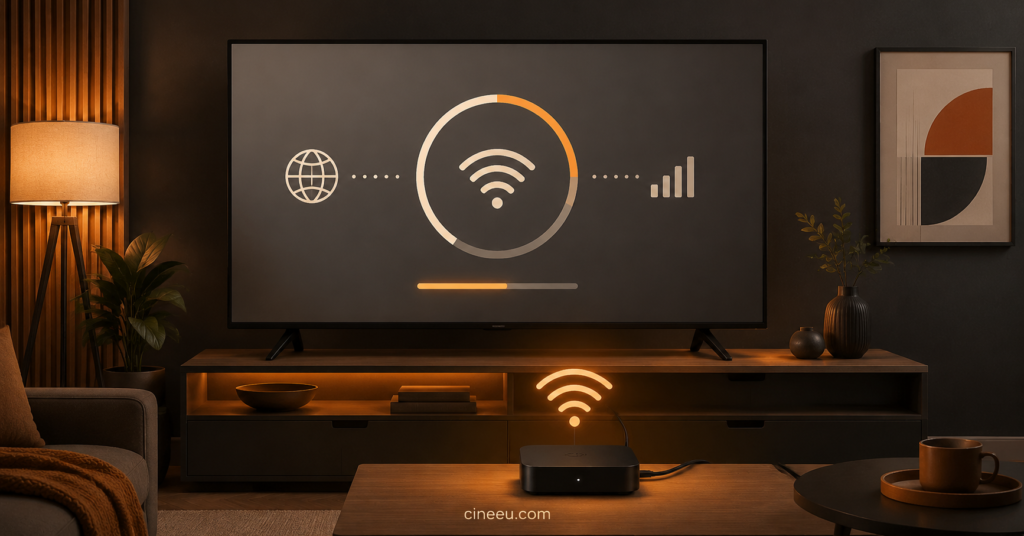
A provider can tick every box above and still disappoint you if your connection isn’t up to the job. Standard-definition and HD streams generally need a stable connection rather than a fast one, since drop-outs cause more visible problems than modest speed does. As a rough guide, HD content is usually comfortable on a stable connection well above 10 Mbps, and 4K needs noticeably more headroom. If your household streams on more than one device at once, that headroom needs to cover all of them, not just one.
Device compatibility deserves the same attention. Most Irish households run a mix of Smart TVs, Firestick devices, and phones, and not every IPTV app behaves identically across all three. Before paying for anything longer than a trial or a single day, install the app on the actual device you’ll use most and watch something live on it, ideally during a busy evening when your household’s broadband is under real load.
Pro tip: If you’re on a shared household connection, test during peak hours rather than mid-afternoon. That’s when problems actually show up.
Wi-Fi extenders and mesh systems help more than most people expect, particularly in older Irish housing stock with thick internal walls. A wired connection to the main streaming device, where it’s practical, still outperforms Wi-Fi for consistency.
If You’re Thinking About Reselling Rather Than Just Watching
Some readers land on a “best IPTV” search because they’re considering the reseller side rather than the viewer side. That’s a genuinely different decision. A reseller panel shifts the questions from device compatibility to operational ones: how credits are priced, whether sub-reseller permissions are available if you want to build a small network under you, and how quickly a parent panel resolves issues when a customer complains. Margins matter, but so does knowing exactly what you’re responsible for if a customer’s stream fails during a big evening of viewing. It’s worth reviewing current IPTV reseller panel options properly rather than picking whichever one a friend mentioned first, since the operational commitment is bigger than most new resellers expect going in.
Signs a Provider Isn’t Being Straight With You
A handful of patterns show up repeatedly among providers worth avoiding, and they’re worth knowing before you hand over payment details:
- They dodge direct questions about content licensing
- Pricing only appears after you message them, never on the website itself
- Payment is only accepted through untraceable methods, with no card or bank transfer option
- Support exists only through a single messaging app, with no way to escalate a problem
- The trial is unusually short or requires full payment details upfront
None of these individually proves a provider is dishonest, but two or more together is a reasonable basis for walking away. It’s also worth checking what you’re actually paying for before assuming a lower monthly figure automatically means a worse service, since pricing structures across providers aren’t always comparable at face value.
Frequently Asked Questions
Do I still need a TV licence if I only watch through IPTV?
Yes. The licence obligation in Ireland applies to any household with equipment capable of receiving live television, regardless of the delivery method.
What broadband speed do I actually need?
A stable connection above 10 Mbps generally handles HD without issue, with more needed for 4K or multiple simultaneous streams in the same household.
Is IPTV illegal in Ireland?
No. IPTV is a delivery technology, not a category of content. The legal risk sits with services distributing copyrighted material, particularly live sport, without proper licensing.
Can I watch on more than one device at the same time?
That depends on the plan. Standard plans usually cover one connection, and providers typically offer a multi-connection option for households that need more.
What happens if a stream drops during a live match?
This is exactly where support quality shows itself. A provider with responsive, human support should resolve the issue within minutes rather than leaving you to restart the app repeatedly.
Deciding What’s Actually Best for Your Household
Best IPTV Ireland 2026 isn’t a single name you can copy from a list and trust blindly. It’s a short, repeatable process: check how the IPTV Reseller panel provider sources its content, confirm pricing is upfront and in euro, test the app on your actual devices during a busy evening, and pay attention to how support behaves before you need it urgently rather than after. Ireland’s enforcement climate makes the licensing question more relevant than it’s been in previous years, so treat a straight answer to that one question as the real filter, and let everything else, price included, come second to it.
Provider Evaluation Checklist for Ireland
- Provider gives a clear, direct answer on content licensing
- Pricing is shown upfront in euro with no hidden steps
- App has been tested on your actual TV, box, or phone
- Trial or short-term option available before a longer commitment
- Support channel and typical response time confirmed in advance
- Multi-device or multi-connection needs checked against the plan
- Household broadband tested during peak evening hours, not off-peak
- TV licence obligation confirmed regardless of delivery method