Book Appointment Now
What Every IPTV Reseller Gets Wrong About Credits (And How to Fix It)
I still remember the first time a reseller client rang me in a panic because his panel had frozen mid-restock, and he had no idea how many IPTV credits had actually gone through before it crashed. That five minute phone call taught me more about this business than any spreadsheet ever has. If you have ever stared at a credit balance wondering where half of it went, you are exactly who this article is for.
IPTV credits sound simple on paper. You buy a batch, you spend them on activations, and you top up when they run low. In practice, they are the single biggest lever that decides whether an IPTV reseller business turns a profit or quietly bleeds money every month. Get the credit side wrong and even the best iptv subscription lineup in the world will not save your margins.
What IPTV Credits Actually Are
At their core, IPTV credits are prepaid units that a reseller spends every time they activate, renew, or extend a customer line on a panel. One credit typically buys one month of service on one connection, though pricing tiers vary wildly between providers. Buy in bulk and the per-unit cost drops, which is exactly why serious resellers rarely purchase small batches.
Think of credits less like currency and more like fuel. You would not fill a car with just enough petrol to reach the next junction, and you should not run an iptv reseller operation on a handful of credits either. Running dry mid-month means lines expire, customers complain, and trust erodes fast.
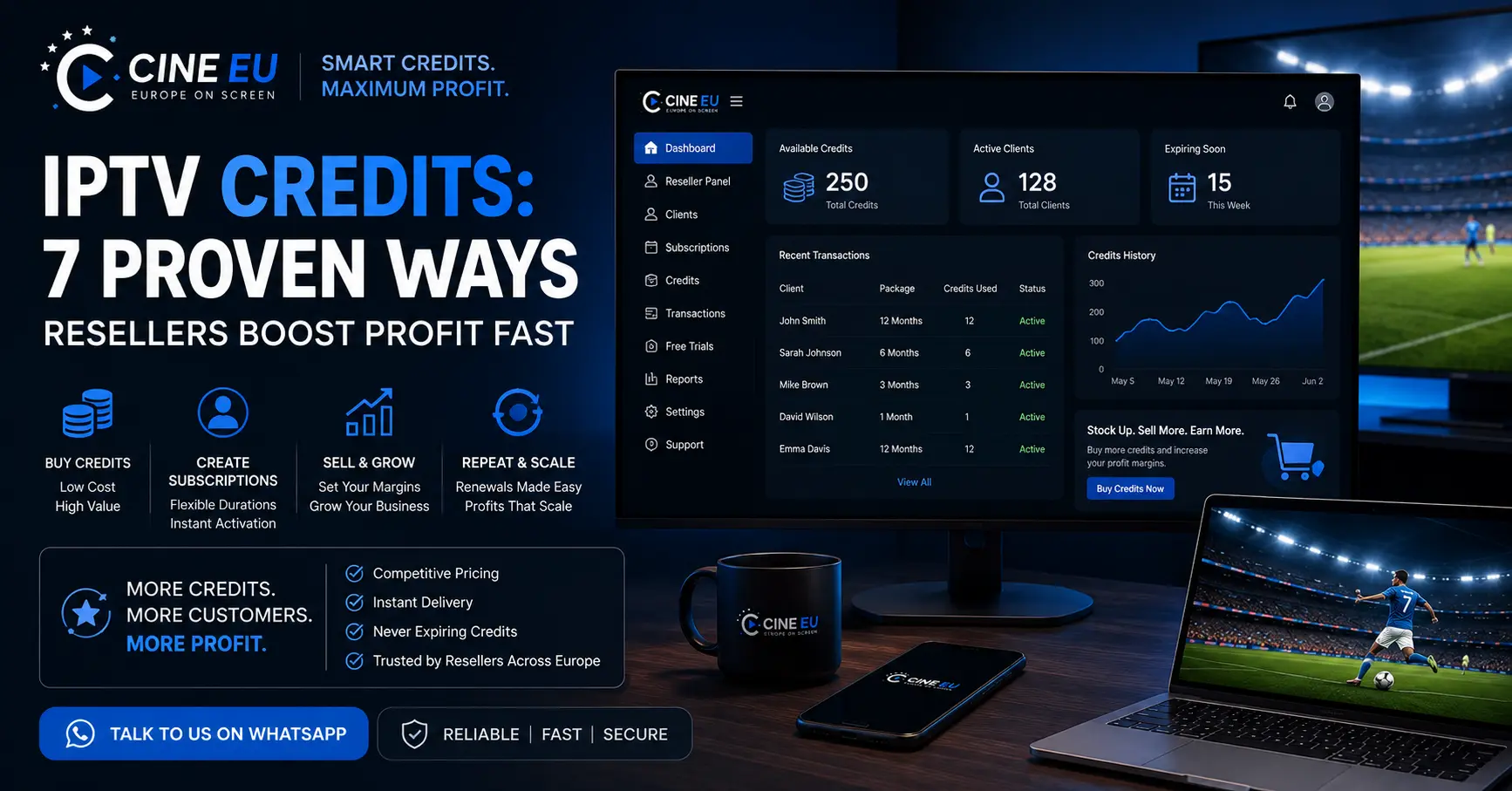
Most panels display your balance in a dashboard, alongside options to restock in fixed packages. Some providers offer rolling monthly credit subscriptions rather than one-off top-ups, which suits resellers with predictable, steady client numbers. Others still prefer pay-as-you-go batches for flexibility during quieter seasons, and there is a genuine argument for either approach depending on how established your client base already is.
New resellers often ask whether it makes sense to buy the biggest batch available straight away. Usually not. Overcommitting to a huge pile of IPTV credits before you have a stable customer base ties up cash that could otherwise fund marketing, support tools, or a proper website.
How the Credit System Works Behind the Scenes
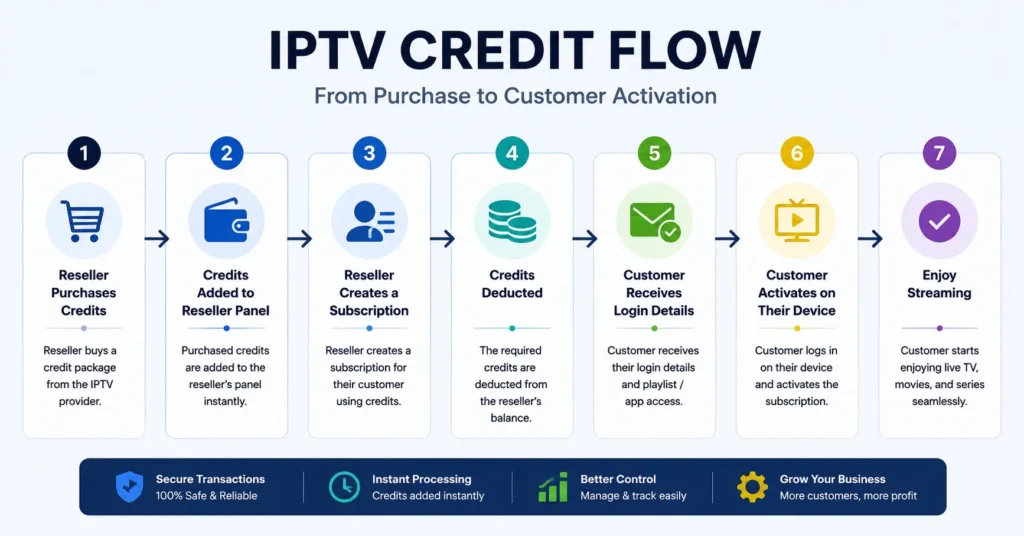
Every activation pulls from your pool the moment you generate a line, whether the customer uses it that day or not. Renewals work the same way, quietly deducting IPTV credits each billing cycle for as long as that customer stays active. This is where a lot of new resellers get caught out, because they forget renewals draw from the same balance as new sign-ups.
Ever wondered why some resellers seem to always have stock while others are constantly begging suppliers for an emergency top-up? It usually comes down to forecasting. Experienced sellers track monthly renewal volume against new customer growth and buy IPTV credits ahead of the curve, not after the balance hits zero.
Panels typically log every transaction, so you can trace exactly which client consumed which credit and when. That kind of visibility matters enormously once you are managing more than a couple of dozen active lines, because manual memory simply cannot keep pace once numbers climb past thirty or forty customers.
It is worth noting that not all panels calculate credits identically. Some deduct a full credit for a partial month renewal, while others prorate the cost. Reading the fine print before committing to a supplier saves confusion later, particularly when a customer requests an early upgrade or downgrade mid cycle.
Why Free IPTV Schemes Almost Always Cost More
Free IPTV offers pop up constantly in reseller forums and messaging groups, promising unlimited access with no credit cost at all. The catch is nearly always reliability, security, or both. Free IPTV sources tend to vanish overnight, leaving resellers scrambling to explain sudden outages to paying customers.
Publications like Cord Cutters News have repeatedly flagged how unstable free streaming sources tend to be compared with properly licensed infrastructure, and that instability lands squarely on the reseller’s reputation. TechRadar has made similar observations about the broader streaming market, noting that consumers increasingly value consistency over rock-bottom pricing. A customer does not care whether the outage was your fault or your supplier’s. They just remember the service that stopped working.
Here is a quick comparison worth sitting with:
| Factor | Free IPTV | Paid Credit-Based Panel |
|---|---|---|
| Uptime reliability | Unpredictable | Consistently monitored |
| Customer support | Rare or nonexistent | Included with most panels |
| Long-term cost | Hidden churn and refunds | Transparent per-credit pricing |
| Reseller reputation risk | High | Low to moderate |
| Scalability | Poor beyond a handful of users | Straightforward with bulk credits |
Paying for IPTV credits is not just a cost. It is insurance against the churn that free alternatives quietly create, and insurance is rarely the exciting purchase but almost always the wise one.
Chasing the Best IPTV Subscription Without Wasting Credits
Every customer wants the best iptv subscription for the lowest possible price, and honestly, who could blame them? Your job as a reseller is balancing that expectation against the real cost of the credits behind each line. Undercutting the market too aggressively means you burn through IPTV credits faster than the margin can support.
A smarter approach is tiering your offers. Basic packages can run on shorter renewal cycles that use fewer credits upfront, while premium packages justify a higher price and a longer commitment. This gives customers genuine choice while protecting your own credit runway, and it also gives you useful data on which tier actually retains customers longest.
It also helps to be upfront with clients about what “best” actually means. The best iptv experience usually blends stable connections, decent device support, and responsive customer service, not just the cheapest monthly rate. Sell that story honestly and renewals tend to look after themselves, because customers who understand what they are paying for rarely feel shortchanged later.
Pricing transparently also reduces support tickets. Confused customers who do not understand why a renewal costs what it does tend to raise disputes, and disputes cost you time even when they do not cost you credits directly.
Panel Comparison: Where Credits Go Furthest
Not every panel treats IPTV credits the same way, and the differences add up over a year. Some platforms charge full credits for trial accounts, others let you issue limited free trials without touching your balance at all. That single difference alone can save or cost hundreds of credits annually depending on how aggressively you market trials.
Support responsiveness matters too. A panel that resolves technical issues quickly protects your credit investment, because unresolved bugs often lead to refund requests, and refunds rarely return the spent credit to your pool.
Ask any experienced reseller and they will tell you the cheapest credits are not always the best value. A panel offering rock-bottom prices but frequent downtime will cost you more in refunded IPTV credits than a slightly pricier, more stable alternative ever would. Weigh the headline price against the support quality before you commit to a large purchase.
Server location matters as well, since buffering complaints often trace back to distance and routing rather than the credit system itself. A panel with servers spread across multiple regions tends to serve a geographically varied customer base far more reliably.
Regional Pricing and Seasonal Demand
Credit pricing is rarely static. Suppliers often adjust rates around major sporting calendars or holiday periods when demand for the best iptv packages spikes sharply. Buying a slightly larger batch just before those windows can lock in a lower per-credit rate before prices climb.
Currency fluctuations play a role too, particularly for resellers buying from suppliers priced in a different currency than their customer base pays in. A weaker exchange rate can quietly erode margins even if your retail pricing has not changed at all. Reviewing your credit cost against your local pricing every quarter catches this before it becomes a real problem.
Seasonal churn is also worth planning for. Some regions see a dip in new sign-ups during summer months and a surge closer to autumn, so timing your bulk IPTV credits purchases around your own historical patterns, rather than a generic calendar, tends to work better.
The Mistakes That Quietly Drain a Credit Balance
I have watched resellers make the same handful of errors over and over, and most of them trace back to poor tracking rather than bad luck. Here are the ones worth guarding against.
- Issuing unlimited free trials without a cap, quietly burning IPTV credits on people who never intended to pay
- Forgetting to cancel lines for customers who cancelled their subscription weeks ago
- Buying small, expensive credit batches instead of planning ahead for bulk pricing
- Ignoring renewal forecasts until the balance is already critically low
- Mixing personal test accounts with client credits on the same pool
- Failing to reconcile the panel’s records against your own customer list on a regular basis
Small mistakes compound quickly when you are managing dozens of lines. Catching them early is far cheaper than discovering a shortfall the week your biggest client is due to renew, and a quick monthly audit is usually enough to keep everything honest.
A Day in the Life of a Credit-Conscious Reseller
Picture a Tuesday morning where a reseller opens their dashboard before breakfast, checks the overnight renewals, and notices the balance has dipped below their usual safety threshold. Instead of panicking, they simply restock because they set that threshold months ago after learning the hard way. That is the entire difference between a stressful business and a boring, reliable one.
Boring, in this line of work, is genuinely the goal. The resellers who last years rather than months are rarely the ones chasing the flashiest free iptv trial gimmick. They are the ones who treat IPTV credits like inventory, because that is precisely what they are, and inventory that runs out at the wrong moment damages relationships that took months to build.
By lunchtime, that same reseller might field two support messages, approve a bulk order for a small business client, and quietly note that one supplier’s response time has slipped lately. None of this feels dramatic day to day, but it is exactly this steady attention that separates resellers who survive their first year from those who do not.
Evenings often bring the quieter admin work, updating a spreadsheet, replying to a customer asking about device compatibility, or comparing that week’s spend against last week’s. It is not glamorous, and nobody builds a highlight reel around reconciling a balance sheet, but this repetitive discipline is what a sustainable reseller business actually looks like once the novelty wears off.
Scaling From a Side Hustle to a Proper Business
Many resellers start small, selling a handful of lines to friends and family before realising there is real demand for a properly run service. The credit system scales with you, but only if your record keeping scales alongside it. Spreadsheets that worked for fifteen customers start to creak at a hundred and fifty.
At this stage, it is worth asking whether your current panel still fits your needs. Some platforms designed for casual resellers lack the reporting depth that a growing business requires, particularly around forecasting how many IPTV credits you will need over the next quarter rather than just the next week.
Growth also changes how you talk to customers. A larger base means more renewal reminders, more billing questions, and more opportunities for a small credit miscalculation to snowball into a support backlog. Investing in basic automation around renewal notifications tends to pay for itself quickly once you pass that fifty customer mark.
There is also the question of who else touches the panel as you grow. Bringing on a part time assistant to handle renewals sounds sensible, but it also means someone other than you can spend a shared balance. Clear internal rules about who can top up, who can issue trials, and who reviews the monthly numbers matter just as much as the supplier contract itself.
None of this needs to feel overwhelming. Most of it comes down to writing your own simple rules once and then actually sticking to them, which sounds obvious but is where a surprising number of growing resellers quietly fall short.
Reseller Checklist for Managing IPTV Credits
- Set a minimum balance threshold and restock before you hit it
- Review renewal volume monthly and adjust future purchases accordingly
- Cap free trials to a fixed number of credits per month
- Reconcile your panel’s transaction log against your own customer records
- Compare credit pricing across providers before committing to a large batch
- Keep a small buffer of spare credits for unexpected renewals or disputes
- Revisit your pricing tiers every few months as credit costs shift
Following even half of that list consistently will put you ahead of most resellers who only think about credits when they run out.
Frequently Asked Questions
What exactly is one IPTV credit worth?
One credit generally covers one month of service on a single connection, though exact value depends on the panel and pricing tier you have chosen. Bulk purchases usually lower the effective cost per credit substantially. Always confirm the conversion rate with your specific provider before assuming standard pricing applies. Some panels also offer different credit costs for trial versus full activations.
Is free IPTV a realistic alternative to buying IPTV credits?
Free IPTV sources tend to be unstable, unsupported, and prone to disappearing without warning, which makes them a poor foundation for a paying customer base. They might work for personal, short-term testing, but building a reseller business around them invites constant outages. Most experienced resellers treat free options as something to avoid rather than rely on for anything beyond casual curiosity.
How do I choose the best iptv subscription tier to resell?
Look at your target customers first and work backward from what they actually need, whether that is device flexibility, channel variety, or price sensitivity. The best iptv subscription for one customer base might be entirely wrong for another. Testing a couple of tiers with a small group before rolling out broadly tends to reveal the right fit faster than guessing.
Do unused IPTV credits expire?
This varies significantly by provider, so it is worth checking terms before buying a large batch you might not use quickly. Some panels allow credits to sit indefinitely, while others impose expiry windows of six to twelve months. Building your purchasing schedule around your actual usage rate avoids this becoming a problem either way.
What is the biggest mistake new IPTV resellers make with credits?
Buying too little too late is the most common issue, usually because new resellers underestimate how quickly renewals stack up alongside new sign-ups. The second most common mistake is treating trials as free when they still draw from the same credit pool as paid activations. Both problems are solved with basic forecasting and a bit of discipline applied consistently.