Book Appointment Now
What Nobody Tells You Before Joining a Reseller Scheme
Three winters ago, a chap called Danny rang me from a supermarket car park in Walsall. He’d bought fifty credits from a scheme he found on a forum, sold the lot to mates within a week, and was now staring at a phone full of angry messages because every stream had collapsed on a Saturday night. He wanted to know what had gone wrong.
The honest answer was simple. Danny had joined an IPTV Reseller Program without checking a single thing about the infrastructure underneath it. At its best, an IPTV Reseller Program lets you buy access to a provider’s platform wholesale, resell it under your own name and keep the margin. At its worst, it’s a quick way to lose money and friends in the same weekend.
I’ve spent fifteen years writing about telecoms, and the last few talking to resellers on both sides of that line. This guide is the conversation I wish Danny and I had had before he spent a penny.
What an IPTV Reseller Program Actually Is
Strip away the marketing and the model is refreshingly plain. A wholesale IPTV service provider runs the servers, the encoding and the delivery network. You buy credits from them through a web dashboard, and each credit converts into a subscription period for one of your customers.
That dashboard is the IPTV panel. It’s where you create lines, set expiry dates, assign connections and check who’s online right now. Think of it as the till and the stockroom of a small shop, rolled into one browser tab.
So what’s the catch? You’re not running the infrastructure, which means you’re not in control of it. When the upstream IPTV service falters, your customers don’t ring the provider. They ring you.
Reseller, sub-reseller and white label
A standard IPTV Reseller Program gives you a panel login and a credit balance, and that’s about it. Higher tiers let you create sub-resellers beneath you, each with their own credit pool. White label arrangements go further still, putting your own branding on the apps, login pages and customer portal.
Each step up costs more upfront. Each one also asks more of your evenings, because sub-resellers need support just as much as end customers do, and they tend to ask harder questions.
The Money Maths Nobody Puts on the Sales Page
Every sales page shows the retail price your customer pays and the wholesale price you pay, then invites you to admire the gap. Fair enough. But that gap isn’t your profit, and the sooner you accept it, the healthier your business will be.
Here’s a worked example I use when someone asks whether an IPTV Reseller Program is worth their time. The figures are illustrative rather than a quote from any supplier, but the shape is realistic for a small UK operation with a hundred active customers.
| Line item | Monthly figure |
|---|---|
| Revenue (100 customers at £10) | £1,000 |
| Credit cost (equivalent of £4 per customer) | £400 |
| Payment processing fees (around 3%) | £30 |
| Refunds and goodwill extensions | £50 |
| Support time (10 hours valued at £12) | £120 |
| Marketing, domain and hosting | £80 |
| Net profit | £320 |
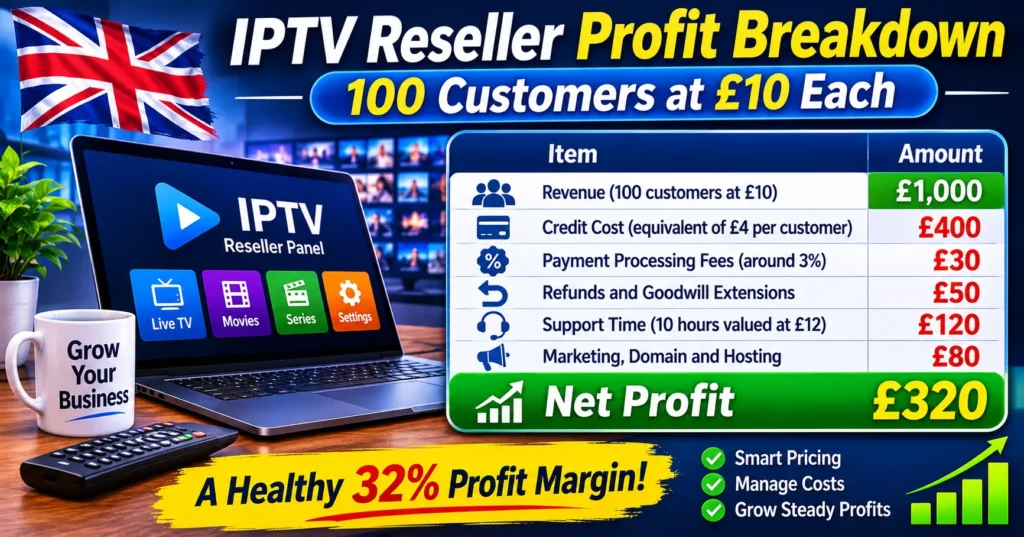
Thirty-two per cent net isn’t bad at all. It’s also a very long way from the sixty per cent that the gross gap suggested. Notice which line hurts most once the business grows: support time scales with customers, and nobody budgets for it properly in month one.
How to Judge an IPTV Service Provider Before You Commit
Choosing the wrong supplier is the single fastest way to wreck a reseller business. I’ve watched people spend weeks perfecting a logo and about four minutes vetting the company that actually delivers the streams. Reverse those proportions and you’re already ahead.
These are the six checks I’d run on any IPTV service provider, in this order:
- Test at peak time, not at your convenience. Ask for a trial line and use it on a Saturday evening when demand is highest. A Tuesday morning test tells you almost nothing about load.
- Ask what happens when the panel goes down. Servers and dashboards are separate systems. If the panel fails, can you still renew a customer, or are you stuck until someone in another time zone wakes up?
- Get credit and refund terms in writing. Find out whether unused credits expire, whether trial lines consume credits, and what happens if the supplier closes its doors.
- Question their failover arrangements. A serious operator balances load across several servers and can reroute traffic when one struggles. If the answer is vague, treat that as the answer.
- Time a support ticket yourself. Send a reasonable technical question through their Telegram or ticket system and note how long a real reply takes.
- Ask about content rights directly. A legitimate business can explain what it’s licensed to distribute. Silence or a joke is a red flag you shouldn’t ignore.
One fair warning about point one. If your test line stutters, it’s worth reading Why Your IPTV Keeps Buffering in Britain (And the Seven Fixes That Actually Work) → /why your iptv keeps buffering in britain before you blame the supplier outright. Sometimes the culprit is a tired home router or a crowded Wi-Fi channel, not the IPTV service at all.
Inside the IPTV Panel: What You’ll Touch Every Day
Every IPTV Reseller Program I’ve reviewed lives or dies by the quality of its dashboard. You’ll open it more often than your email, so clunky design isn’t a cosmetic problem. It’s a daily tax on your time.
Line creation and trials
Creating a line should take seconds: a username, a package, a connection count and an expiry date. Good panels let you issue short trial lines that don’t eat a full credit, which matters enormously when you’re converting cautious new customers.
Connection limits
Most lines are sold with one or two simultaneous connections. Your IPTV panel should show you live sessions, so you can spot a customer quietly sharing a login across three households and have a polite word before it affects server load.
Credit logs and audit trails
Whenever credits move, there should be a timestamped record. I can’t stress this enough if you ever take on sub-resellers, because disputes about who spent what are far easier to settle with a log than with a memory.
Xtream Codes API and M3U output
Customers will connect through apps such as TiviMate or IPTV Smarters Pro, usually using Xtream Codes API credentials or an M3U playlist link. A decent panel generates both cleanly. If you find yourself manually editing URLs for every customer, the tooling is letting you down.
Seven Proven Steps to Launching Your IPTV Reseller Program
You’ve done the vetting and you’ve seen the numbers. Now comes the part that actually builds a business rather than a hobby that occasionally pays for a takeaway.
1. Pick your audience before your provider
Who are you selling to? Expats wanting home content, sports-mad pub regulars and tech-savvy families all want different things. Knowing your customer first makes choosing a supplier far easier, because you’ll know which features genuinely matter.
2. Start with a small credit purchase
Resist the bulk discount on day one. Buy enough credits for your first ten or twenty customers, prove the supplier performs, and scale up only once you trust them.
3. Write your support scripts in advance
Most questions fall into a handful of buckets: installation, login errors, buffering and renewals. Draft clear answers to each before your first sale and you’ll handle the evening rush without panic.
4. Set renewal reminders from the start
Churn rarely happens because customers are unhappy. It happens because they forget. A simple reminder five days before expiry, sent through WhatsApp or email, protects your recurring revenue more than any discount ever will.
5. Choose a payment method with a paper trail
Card processors and bank transfers create records. Cash and crypto paid into personal wallets create headaches, both for your bookkeeping and for HMRC when it comes calling about undeclared income.
6. Keep your branding modest at first
A clean landing page and a professional email address are enough to begin. Your IPTV Reseller Program doesn’t need a custom app until you’ve proved people will stay with you for more than a month or two.
7. Review the numbers every month
Revisit the table above with your real figures. If support hours are creeping up while customer numbers stay flat, something upstream is wrong, and you’ll want to know before your margin vanishes.
Where New Resellers Quietly Lose Money
Picture this. You’ve got forty happy customers, the supplier has been flawless for three months, and you finally treat yourself to a weekend in the Lakes. On Saturday night the servers wobble, your phone has no signal, and by Monday six customers have asked for refunds and two have left negative comments on your Facebook page.
None of that was really your fault. Yet every bit of it landed on you, because that’s how an IPTV Reseller Program works: you carry the reputational risk for infrastructure you don’t control. The fix isn’t to never take a holiday. It’s to have a backup contact, a written outage message ready to send, and a supplier whose status updates you can actually rely on.
Discounting is the other silent killer. Why would a customer pay full price next month if you gave them three months for the price of two last time? Generous offers feel good, but they train people to wait for the next one, and your IPTV Reseller Program becomes a race to the bottom against the reseller down the road.
Overselling connections deserves a mention too. Selling a two-connection line to a family of five feels like extra revenue until they hit the limit at teatime and blame your IPTV service for “not working.”
The Legal Question You Can’t Skip
I’d be doing you a disservice if I glossed over this. In the UK, the Copyright, Designs and Patents Act 1988 makes it an offence to distribute copyrighted content without permission, and the Intellectual Property Office has been clear that selling access to unlicensed streams carries real legal risk. The Federation Against Copyright Theft has pursued resellers, not just the operators at the top of the chain.
Here’s the distinction that matters. Panel software, billing tools and streaming technology are perfectly legal products in their own right. Content rights are a separate question entirely, and a credible IPTV Reseller Program should be able to tell you exactly what its catalogue is licensed for.
My editorial view is straightforward: treat any supplier that can’t answer that question as unsuitable, however tempting the wholesale price. If you’d like more detail on telling the two apart, see choosing a licensed IPTV panel. Ofcom’s research on online streaming habits is also worth reading, simply to understand what legitimate services in Britain look like.
Your Pre-Launch Checklist
Before you buy your first serious batch of credits through any IPTV Reseller Program, run down this list:
- You’ve tested a trial line during Saturday evening peak hours
- Credit expiry, refund and closure terms are in writing
- Your supplier has answered the content licensing question clearly
- Support scripts for installation, logins, buffering and renewals are drafted
- You have a renewal reminder system ready to switch on
- Payments go through a method that leaves a proper record
- You know your break-even customer number from your own figures
- There’s a backup plan for outages when you’re away
A Final Word Before You Buy Credits
Danny, for what it’s worth, is still in the business. He switched suppliers, cut his customer list to people he could genuinely support, and now runs a tidy little operation with a margin he’s proud of. The difference wasn’t luck. It was asking better questions before signing up rather than after.
That’s really the whole lesson. An IPTV Reseller Program rewards patience, honest maths and a supplier you’d trust with your reputation, because that’s precisely what you’re handing over. Do the checks, start small, and build something your customers will still be paying for next winter.
Frequently Asked Questions
How much money do I need to start an IPTV Reseller Program?
Most suppliers set a minimum credit purchase, which can range from a modest sum to several hundred pounds. I’d suggest starting at the lower end so you can test the supplier with real customers before committing more. Set aside a small budget for a domain, basic hosting and payment fees too. Starting lean protects you if the supplier turns out to be unreliable.
What is the difference between an IPTV panel and an IPTV service?
The IPTV panel is the management dashboard you use to create lines, track credits and monitor connections. The IPTV service is the actual streaming delivery your customers watch through their apps. You can have a polished panel sitting on top of poor infrastructure, which is why testing both matters. Judge them separately before you buy.
Can I run an IPTV Reseller Program part-time?
Yes, plenty of resellers start alongside a day job. The challenge is that support requests cluster in the evenings and at weekends, exactly when you’d rather be off duty. Pre-written support scripts and renewal reminders make part-time operation far more manageable. Expect to scale back customer numbers if you can’t respond reasonably quickly.
How do I know if an IPTV service provider is trustworthy?
Look for written terms, responsive support and a clear answer about what content they’re licensed to distribute. Test their service at peak times rather than quiet ones. Ask other resellers about their experience, but weigh forum opinions carefully, since some posts are promotional. A provider that dodges direct questions usually has something to hide.
Do I need my own app to resell?
Not at the start. Most customers are comfortable using established players such as TiviMate or IPTV Smarters Pro with the login details you provide. A branded white label app becomes worthwhile once you have a stable customer base and want to strengthen loyalty. Until then, it’s an expense that rarely pays for itself.

[…] out rather than scaling up? Read What Nobody Tells You Before Joining a Reseller Scheme → /what nobody tells you before joining a reseller scheme before committing any […]