Book Appointment Now
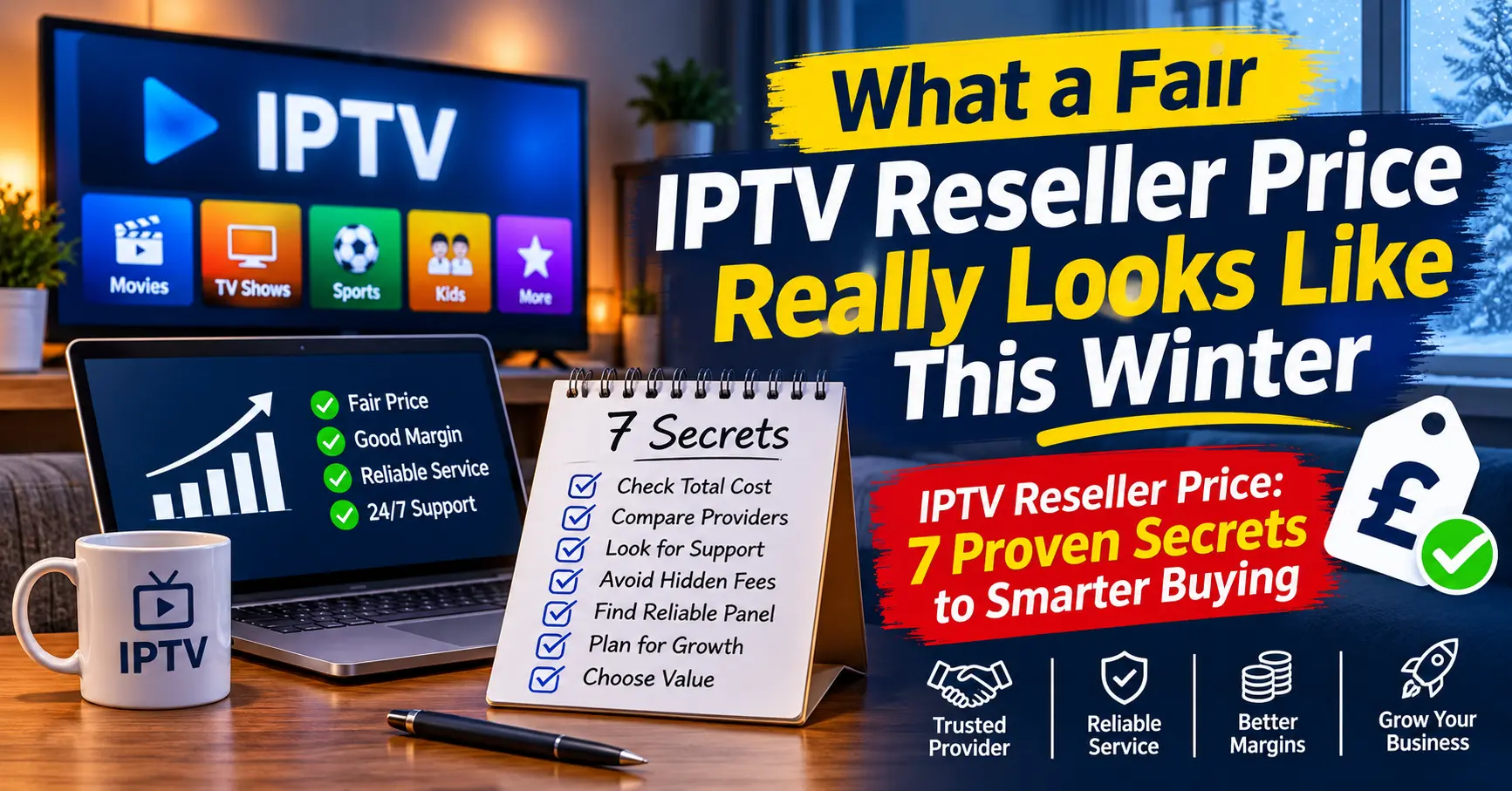
What a Fair IPTV Reseller Price Really Looks Like This Winter
The Halloween banners came down on most reseller sites last weekend, and my inbox did what it always does in early November. Three messages arrived in one morning, all asking roughly the same thing: what’s a fair IPTV reseller price right now, and am I being ripped off?
Here’s the short answer. A fair IPTV reseller price isn’t the lowest number on a pricing page; it’s the one that leaves you a healthy margin after panel fees, payment charges, support time and the odd refund. Most credit packs I’ve reviewed for sellers this year sit somewhere between about £1 and £3 per monthly credit, with volume pulling the figure down and premium support pushing it up.
So why does the question keep coming up? Because the headline figure hides more than it reveals. After fifteen years of watching this corner of telecoms, I’ve learned that the cheapest panel rarely ends up being the cheapest panel.
The Number on the Page Is Only Half the Story
Picture two sellers in Leeds. Both start with £300, both pick a panel on the same evening, and both are chasing the same group of customers through a local community page.
One goes for the lowest IPTV reseller price he can find. The other pays roughly a third more per credit to an IPTV panel provider with a responsive support desk, a clean dashboard and a published uptime record.
Six months later, the first seller has spent most of his evenings answering “it’s buffering again” messages and has refunded four customers. The second has fewer clients, admittedly, yet almost all of them renewed without a nudge.
That hypothetical isn’t far from what I’ve watched happen dozens of times. Price matters enormously, of course. But price per credit and cost per loyal customer are two very different numbers, and only one of them pays your rent.
Why November Pricing Feels So Messy
Seasonal promotions muddy the water every year. October brings themed credit bundles, Black Friday arrives within a few weeks, and sellers end up comparing a discounted rate from one provider with a standard rate from another.
Promotional pricing isn’t dishonest in itself. Providers use it to clear capacity, win market share or reward loyal resellers, and I’ve seen some genuinely excellent deals land at this time of year.
Trouble starts when a temporary rate gets treated as the permanent IPTV reseller price. A seller builds their retail pricing around a 30 percent discount, the promotion ends, and suddenly the margin they’d planned on simply isn’t there.
My rule of thumb is simple. Work out your retail prices using the provider’s standard rate, and treat any promotional saving as a bonus rather than a foundation.
Plenty of readers have asked whether the autumn offers still floating around are worth chasing, and I unpicked that question properly in Halloween Has Gone, but Are the IPTV Deals Still Worth Grabbing? → /halloween iptv deals still worth grabbing. The short version? A discount on a weak provider is still a weak provider.
What You’re Really Paying For Inside an IPTV Reseller Price
Before comparing anyone’s rates, it helps to know what’s actually being sold. Most panels in the IPTV reseller UK market work on credits, and a single credit typically equals one month of access for one subscriber connection.
Credits and How They’re Counted
Credits are the currency of the whole model. You buy them in bulk from your provider, then spend them inside the panel each time you create or extend a line for a customer.
Where it gets interesting is the conversion rate. Some panels charge one credit per month regardless of connections, while others charge extra credits for a second or third device on the same account, which quietly changes your effective IPTV reseller price by a wide margin.
The Panel Itself
Then there’s the software layer. A decent reseller dashboard lets you create trial lines, set expiry dates, reset devices and see at a glance who’s due for renewal next week.
Some providers bundle all of this into the credit cost. Others charge a one-off activation fee, usually framed as a “starter pack”, which can range from modest to frankly cheeky.
Setup Fees and Sub-Reseller Rights
Should you want to appoint your own sub-resellers later, check whether the panel allows it at your tier. Some providers lock that permission behind a higher spend threshold, which effectively raises your entry cost if growth is part of the plan.
Support, Uptime and the Invisible Extras
Finally, you’re paying for the people behind the panel. When a customer’s line stops working at 9pm on a Saturday, the speed of your provider’s reply becomes the most important line item you never saw on the invoice.
Infrastructure quality sits here too. A reliable IPTV service depends on server capacity, load balancing and sensible routing, and those costs eventually show up in what you pay per credit, whether the provider admits it or not.
Seven Things the Price List Won’t Tell You
I’ve read hundreds of reseller pricing pages over the years. These are the gaps I see most often, roughly in the order they tend to bite.
- Volume tiers aren’t always generous. A 500 credit pack might only save you 10 or 15 percent over a 100 credit pack, which matters if it locks up cash you’ll need in January.
- Credits can expire. A few panels put an expiry window on unused credits. Ask before you buy, not after.
- Multi-device lines cost more than you think. If a customer wants three connections, check whether that’s one credit or three. It can change your IPTV reseller price per customer overnight.
- Trial lines may draw from your balance. Free trials are brilliant for conversions, but some panels deduct a fraction of a credit for each one you create.
- Payment methods carry their own fees. Card processors such as Stripe or PayPal take a slice of every sale, and cross-border transfers through Wise or a high street bank add another.
- Refund policies vary wildly. Some providers will credit back a line that never worked. Others won’t, full stop.
- Price rises arrive quietly. Watch for “updated pricing” notices in Telegram channels or panel announcements, especially after seasonal promotions end.
None of these is a scandal on its own. Stack three or four together, though, and a seemingly cheap IPTV reseller price can end up costing you more than the premium option you dismissed.
Three Buying Models Compared Side by Side
Broadly, UK sellers buy access in one of three ways. I’ve laid them out below, with the trade-offs I’d want any new reseller to weigh honestly.
| Buying model | Typical cost pattern | Best suited to | Main drawback |
|---|---|---|---|
| Small credit packs (10 to 50 credits) | Highest IPTV reseller price per credit | Testing a provider or a new niche | Thin margins on every sale |
| Mid-volume packs (100 to 300 credits) | Moderate per-credit discount | Established sellers with steady renewals | Cash tied up between renewal cycles |
| Master or sub-reseller panel access | Lowest per-credit rate, often with a setup fee | Sellers managing their own resellers | More admin, more responsibility, more risk |
There’s no universally right row in that table. If you’re new, I’d honestly start small even though the per-credit maths looks worse, because finding out a provider is unreliable after buying 300 credits is a painful lesson.
Experienced sellers tend to drift towards the middle row. The master panel route suits a narrow group, mostly people who already run a team and treat this as a proper business rather than a side income.
Sizing Up an IPTV Panel Provider Before You Pay
A good IPTV panel provider earns its rate in the small details. When I’m assessing one on behalf of a client, these are the checks I run first.
- Ask for a trial reseller account, even a tiny one, so you can see the dashboard before committing real money.
- Time their support. Send a simple question on a weekday evening and note how long the reply takes.
- Check whether the panel works smoothly with common player apps such as TiviMate, IPTV Smarters Pro and standard M3U playlists.
- Look for independent reviews on Trustpilot or long-running reseller forums, and read the three-star ones, which are usually the most honest.
- Confirm how billing works: pounds, euros or dollars, and whether VAT applies to your purchase.
- Ask directly how they handle content licensing and rights, and walk away from anyone who dodges the question.
This last point deserves a moment. The UK Intellectual Property Office and the Federation Against Copyright Theft (FACT) have both been vocal about unlicensed streaming, and as a seller you carry real exposure if the content behind your panel isn’t properly cleared.
Technology vendors and content distributors are different things. A reputable provider supplies infrastructure, software and support, and is open about where the rights responsibility sits; a vague answer here is a stronger warning sign than any price tag.
Red flags are worth naming plainly. Pressure to buy a large pack immediately, no written refund terms, payment only through untraceable methods and support that vanishes after the sale are all reasons to keep looking.
Is a Rock Bottom IPTV Reseller Price Ever Worth It?
Sometimes, yes. I don’t want to pretend that every low-cost provider is cutting corners, because some genuinely run lean operations and pass the savings along.
Low pricing tends to work when you’re selling to a small, tech-confident audience who don’t need hand-holding. Think of a seller with a dozen friends and colleagues as customers, people who are happy to reinstall an app themselves when something hiccups.
It tends to fail when your customers expect a polished IPTV service that simply works. Families, older viewers and anyone who’s switched from a mainstream TV package usually judge you on reliability first and price a distant second.
Price also signals positioning to your own customers. Buy cheap and sell cheap, and you’ll attract bargain hunters who leave the moment someone undercuts you by a pound.
Ask yourself honestly: who are you actually selling to? If you can’t answer that in a sentence, comparing IPTV reseller price lists is premature, because the right rate depends entirely on the customer you’re serving.
Which? has published plenty over the years about consumers chasing headline deals and paying for it later in hassle and wasted time. The same logic applies one rung up the ladder, to resellers buying wholesale.
A Worked Margin Example From a Small UK Seller
Numbers make this real, so here’s an illustrative one. Imagine a seller running an IPTV reseller UK operation from a spare room in Birmingham, with 60 active customers paying £12 a month.
Assume they’ve negotiated an IPTV reseller price of £2 per monthly credit through a mid-volume pack. Their monthly picture looks something like this.
- Revenue: 60 customers at £12 comes to £720.
- Credit cost: 60 credits at £2 comes to £120.
- Payment processing at roughly 3 percent: about £22.
- Refunds and goodwill extensions, say two lines: £24 in lost revenue.
- Tools such as a basic website, a support number and a Google Sheets tracker: around £25.
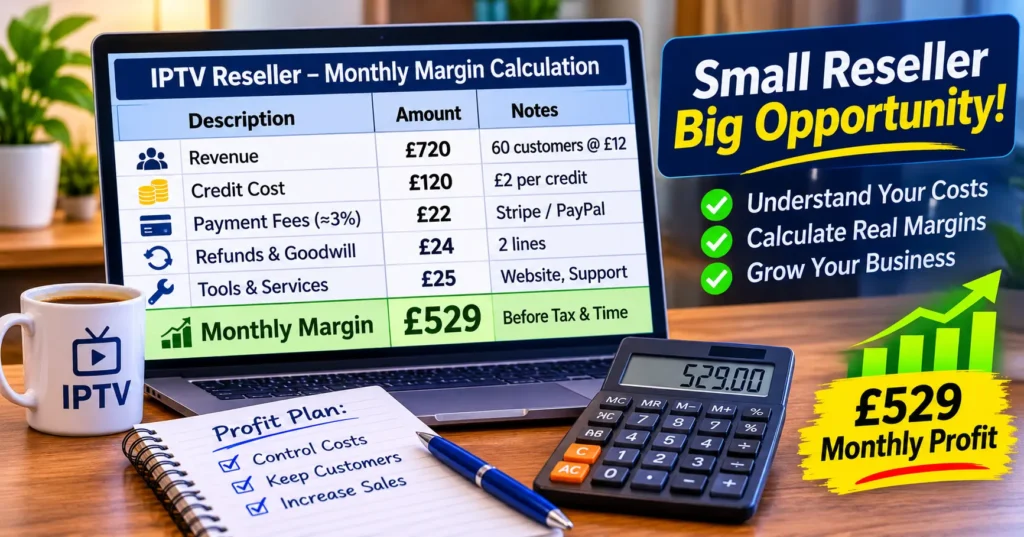
Roughly £529 remains before tax and before the seller puts any value on their own time. Not bad on paper.
Now nudge the scenario. Switch to a provider charging £1.40 per credit, saving £36 a month, but suppose the weaker support means six customers churn instead of renewing.
Those six lost customers cost £72 a month in revenue, which wipes out the saving twice over. A cheaper IPTV reseller price only wins if retention holds steady.
Another angle is time. If that seller spends ten hours a month on support with the reliable provider and twenty-five with the cheaper one, the hidden hourly cost is enormous, even before stress enters the picture.
Ofcom’s research into UK viewing habits keeps showing that households now juggle several streaming subscriptions and cancel them with little hesitation. That’s exactly why retention, not wholesale cost, is where most resellers should focus their energy.
Your Checklist Before the Next Top-Up
Pin this somewhere near your desk. It’s written for resellers rather than end subscribers, so skip it if you’re simply shopping for a personal plan.
- Compare your current IPTV reseller price against at least two alternatives every quarter.
- Calculate cost per retained customer, not just cost per credit.
- Confirm whether credits expire and whether multi-device lines cost extra.
- Test support response times yourself before recommending a panel to any sub-reseller.
- Get your IPTV panel provider’s position on infrastructure, rights and refunds in writing.
- Keep at least one month of credit costs in reserve so a supplier problem doesn’t become a cash crisis.
- Judge any seasonal deal on its own terms, never because a countdown timer says so.
Where I’d Put My Money This Winter
If a reseller friend rang me tonight and asked where to spend their next £300, I wouldn’t send them to the cheapest name on a comparison thread.
I’d tell them to pick a mid-priced IPTV panel provider with proven support, buy a modest pack, and spend the first month obsessing over customer experience rather than squeezing another 20p off each credit.
Winter is the season when viewers lean hardest on their IPTV service, and it’s when weak infrastructure gets found out. The right IPTV reseller price is the one that still looks sensible in February, after the renewals have come in.
Get that decision right and the rest of the business gets noticeably easier. Get it wrong, and no amount of clever marketing will rescue the margin.
Frequently Asked Questions
What is a typical IPTV reseller price in the UK?
Most credit-based panels I’ve reviewed price a monthly credit somewhere around £1 to £3, depending on pack size and support level. Smaller packs sit at the top of that range, while larger volume purchases bring the per-credit cost down. Treat any figure far outside that band with curiosity rather than excitement. Always confirm how many credits a multi-device line consumes before comparing providers.
How do credits affect the overall IPTV reseller price?
Every line you create or renew uses credits, so your real cost depends on how the panel converts credits into customer access. A provider charging slightly more per credit, but only one credit per multi-device line, can work out cheaper than a budget panel charging per device. Expiry rules matter too. Unused credits that lapse are simply money gone.
Is it worth starting an IPTV reseller UK business in 2026?
For the right person, yes, though it rewards patience and good customer care far more than aggressive pricing. You’ll need a dependable provider, a clear understanding of content rights and a plan for support outside office hours. Margins can be healthy at modest scale. Anyone expecting passive income with no customer contact will likely be disappointed.
How can I tell if an IPTV panel provider is reliable?
Start with a small trial account and judge the dashboard, support response times and stability over at least a couple of weeks. Look for independent reviews rather than testimonials on the provider’s own site. Ask direct questions about infrastructure, refunds and rights, and note how specifically they answer. Vague replies usually signal deeper problems.
Should I pass every wholesale price change on to my customers?
Not always. Small wholesale increases are often better absorbed for a few months, especially if your customers are loyal and renewing smoothly. Larger rises usually need to be passed on, ideally with some notice and a short, honest explanation. Customers of an IPTV service tend to accept fair increases far more readily than surprise ones.

[…] I’ve written one separately: What a Fair IPTV Reseller Price Really Looks Like This Winter → /fair iptv reseller price winter. It’s worth reading alongside this guide if you’re weighing up wholesale rates before the busy […]