Book Appointment Now
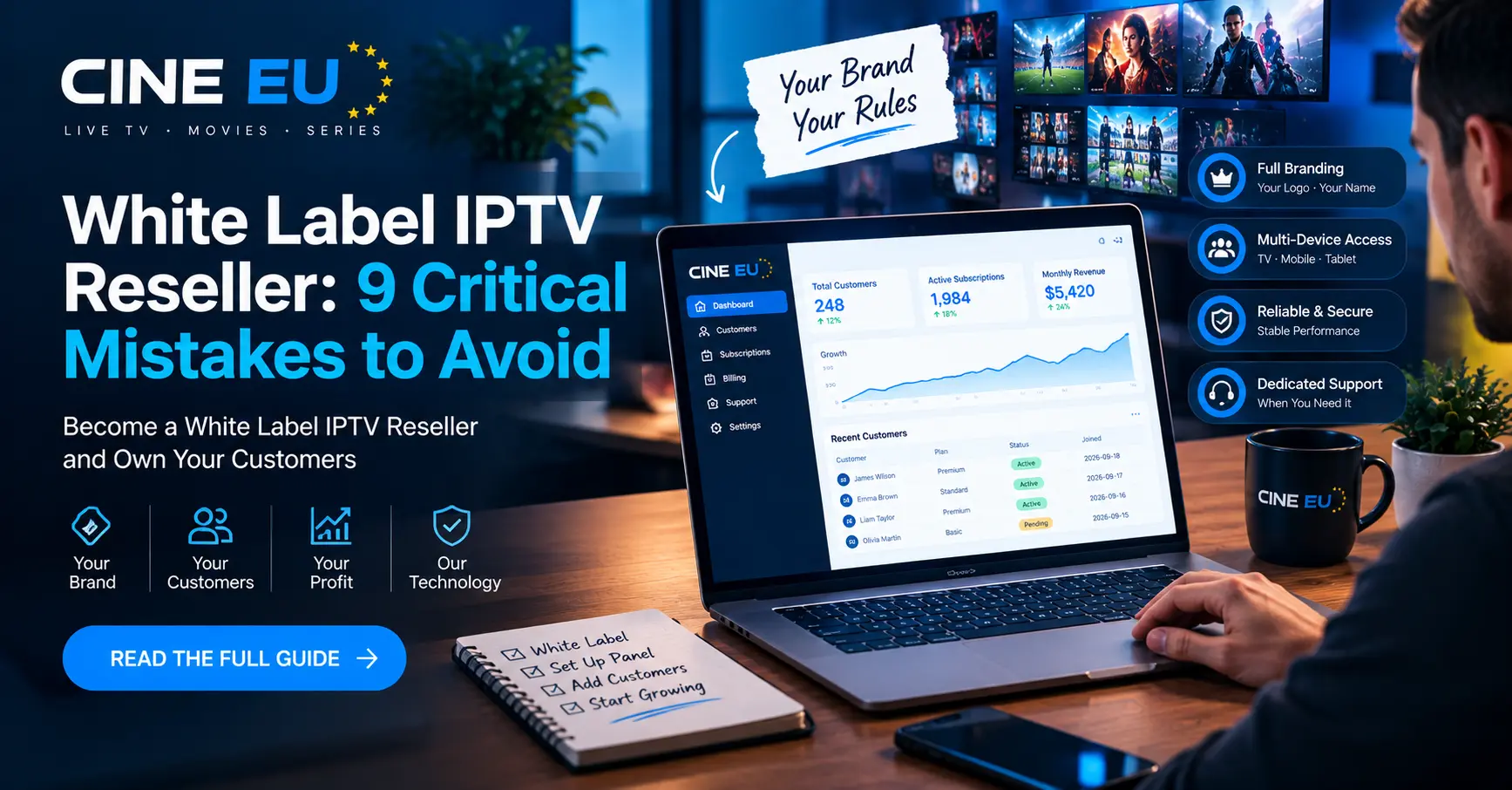
Become a White Label IPTV Reseller and Own Your Customers
A friend of mine in Coventry sold his first twelve subscriptions from the front seat of a parked car. No website. No logo. No clue what a load balancer was, and no particular interest in finding out. Six weeks later he had forty paying customers and one very awkward problem: every single one of them knew his supplier’s brand, not his. That car park moment is exactly what a white label IPTV reseller arrangement is designed to prevent.
Here’s the short version before we go any further. A white label IPTV reseller buys streaming infrastructure and capacity from an upstream technology vendor, then sells it under their own brand, their own pricing, and their own customer relationship. The vendor stays invisible. You become the business your customers actually remember, which is the only version of this trade that compounds over time.
I’ve spent the better part of fifteen years writing about telecoms and digital distribution, and I’ve watched this particular corner of the market mature from something chaotic into something that, handled properly, looks like a fairly ordinary subscription business. The people who do well are rarely the ones with the flashiest landing page. They’re the ones who avoided the nine traps below.
What White Label Actually Means Once the Money Starts Moving
Strip away the marketing and a white label agreement is a wholesale supply deal with a branding clause attached. You purchase credits or capacity at a wholesale rate. You resell at retail. The margin between those two numbers is your entire business, and the branding clause is what stops your supplier from becoming your competitor.
That last part matters more than most newcomers realize. A plain reseller account often exposes the upstream brand somewhere in the customer journey, in a portal login, a support email, a panel header. A proper white label IPTV reseller setup removes those fingerprints entirely, replacing them with your domain, your colours, your support address.
Is the distinction worth paying extra for? Almost always, yes. The moment a customer can find your supplier without you, your renewal rate becomes somebody else’s asset. I’ve seen resellers lose a third of their base in a single quarter because a support ticket leaked an upstream domain name into a customer inbox.
There’s a second, quieter benefit. Owning the brand means owning the data: who churns, who upgrades, who refers. Without that, you’re guessing.
Mistake One: Buying Capacity Before Buying Stability
New resellers shop on price per credit. Experienced ones shop on uptime, and there’s a reason for that gap. A cheap credit that fails during peak evening hours costs you the customer, the refund, and the review.
Before committing to any white label IPTV reseller supply agreement, ask for a live trial window across your actual customer geography. Not a demo. A real test, run for at least seven days, during the hours your buyers will actually be watching.
Peak-hour congestion is a genuinely under-discussed problem. Sandvine’s long-running Global Internet Phenomena reports have documented for years how video traffic dominates evening bandwidth across residential networks, which means your infrastructure gets its hardest test at precisely the moment your customers care most.
Test what breaks. Then test how quickly it comes back.
Mistake Two: Letting Your Supplier Own the Customer
This is the car park problem, and it’s the fastest way to build a business you don’t actually own. If billing, support, and account access all run through an upstream system that isn’t yours, you’re being paid a finder’s fee, not running a company.
A serious white label IPTV reseller controls three things without exception: the payment relationship, the support channel, and the login surface. Everything else can be outsourced. Those three cannot.
Practically, that means your own checkout, your own ticket system or shared inbox, and a client area on your own domain. It doesn’t need to be expensive. It needs to be yours.
I’d rather see a reseller running a tidy WordPress site with a simple payment gateway than a slick supplier-hosted storefront they’ll never be able to migrate away from.
Mistake Three: Pricing Out of Panic
Someone in a forum undercuts you by three pounds and the instinct is to match them within the hour. Resist it. Price wars in this sector are usually won by whoever is willing to lose money longest, and that’s not a competition worth entering.
The healthier approach is to price against value delivered rather than against the loudest competitor. A white label IPTV reseller offering same-day setup, a real human on support, and a documented uptime record is not selling the same product as an anonymous seller with a messaging app and a hope.
Think about the last subscription you personally cancelled. Was it because of price, or because something felt unreliable and nobody answered you? For most people it’s the second one.
Build your tiers around commitment length and support level, not a race to the floor.
Mistake Four: Treating Support as an Afterthought
Support is not a cost centre in this business. It is the product experience, because everything else is invisible infrastructure the customer never sees.
Set a published response window and hit it. Four hours is achievable for a solo operator using a shared inbox and canned replies. Twenty-four hours is fine if you say so upfront. Silence is what kills you.
Write five template responses before you take your first payment: setup on a smart TV, setup on a mobile device, buffering triage, renewal reminder, and refund policy. Those five cover roughly eighty percent of what lands in your inbox in month one.
A white label IPTV reseller with excellent support and average infrastructure will outperform the reverse almost every time. That isn’t a comfortable truth for the engineering-minded, but it holds.
Mistake Five: Ignoring the Compliance Shape of the Business
This is the section nobody enjoys and everybody needs. The regulatory picture around streaming distribution differs sharply by market, and it changes. Ofcom has published extensively on content distribution obligations in the UK, and anyone building a business that touches this space should be reading primary sources rather than forum summaries.
Get the boring parts right early. Register the entity properly. Keep clean records of what you purchased and from whom. Understand your obligations around consumer refunds, data protection, and terms of service in every market you sell into.
A white label IPTV reseller operating as a legitimate technology and infrastructure business is a fundamentally different proposition from someone improvising. The first can open a business bank account, run advertising, and sell the company later. The second cannot.
If a supplier is vague about their own licensing and compliance posture, treat that vagueness as information.
Mistake Six: One Supplier and No Plan B
Single-supplier dependency is the structural weak point in nearly every reseller business I’ve reviewed. Your customers experience your brand, but your continuity depends entirely on someone else’s decisions.
The fix isn’t complicated, just unglamorous:
- Maintain a secondary supply relationship, even at low volume, so you have a tested fallback rather than a theoretical one.
- Keep your customer records in a system you control, exported regularly, in a format you could migrate in an afternoon.
- Document your onboarding process so a supplier switch doesn’t require rebuilding institutional knowledge from memory.
That second point deserves emphasis. A spreadsheet you own beats a dashboard you rent.
Resellers who survive supplier disruption are not lucky. They rehearsed.
Mistake Seven: Branding That Stops at the Logo
Picking a name and a color palette takes an afternoon. Building a brand that survives a support failure takes considerably longer, and most white label IPTV reseller operations stop at the afternoon.
Brand, in this context, is a set of promises you keep repeatedly: how fast you reply, how you handle a refund request, whether your renewal reminders arrive before the service lapses rather than after. Those are the things customers describe when they recommend you.
Your visual identity should at minimum cover the client portal, the email templates, the invoice, and the setup documentation. Anything a customer reads should feel like it came from the same place.
One small detail with outsized impact: send setup instructions as a proper branded guide rather than a copied block of text. It costs nothing and changes how professional you appear.
Mistake Eight: Measuring the Wrong Numbers
Total customer count is the vanity metric of this sector. It tells you almost nothing about whether the business is healthy.
Track these instead:
- Monthly churn rate, expressed as a percentage of the active base.
- Average revenue per user, calculated after refunds rather than before.
- Renewal rate at the ninety-day mark, which is where most subscription businesses lose people.
- Support tickets per hundred customers, as a proxy for infrastructure quality.
- Acquisition cost per paying customer, including the time you spend answering pre-sales questions.
That fourth metric is the one resellers skip and later regret. A sudden rise in tickets per hundred customers is an early warning that your upstream capacity is degrading, usually two or three weeks before it shows up in churn.
Statista’s subscription commerce data has consistently shown retention economics outperforming acquisition spend across digital services, and this niche is no exception. Keeping a customer is cheaper than replacing one, every single time.
Mistake Nine: Growing Faster Than Your Systems
Growth exposes every shortcut you took. The manual renewal tracking that worked beautifully at thirty customers becomes a daily crisis at three hundred.
Before you scale advertising spend, automate three things: payment collection, renewal reminders, and credential delivery. Those three consume the overwhelming majority of a white label IPTV reseller’s admin time, and all three can run without you.
Here’s a question worth sitting with. If you tripled your customer base next month, would that be a good week or a catastrophic one? If the honest answer is catastrophic, fix the systems before the marketing.
Slow, boring, systematic growth beats a spike you can’t service.
White Label IPTV Reseller Models Compared
Not every arrangement suits every operator. The table below covers the three structures I see most often, and their honest trade-offs.
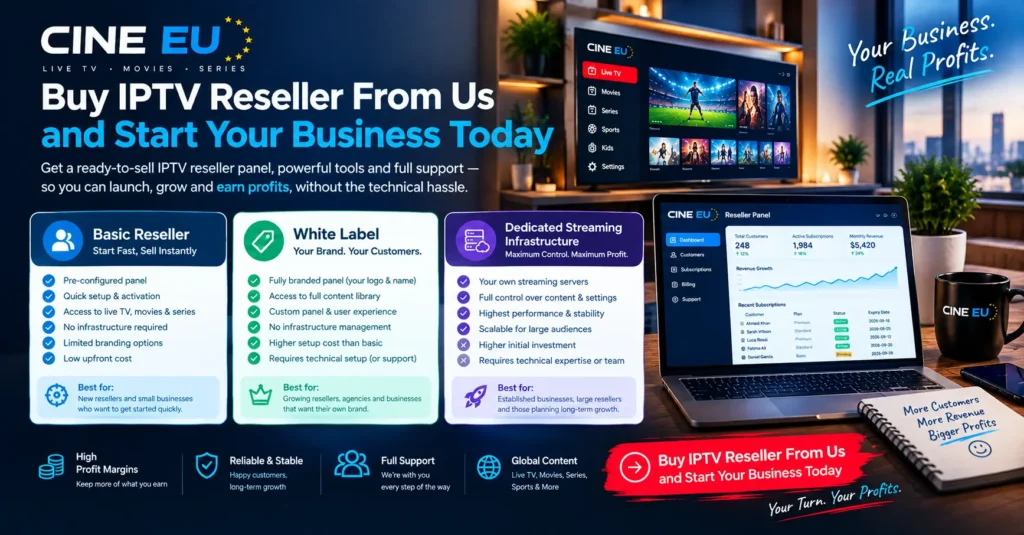
| Model | Upfront Cost | Brand Control | Best Suited To | Main Drawback |
|---|---|---|---|---|
| Basic reseller account | Low | Minimal, supplier visible | Testing demand, side income | Customers discover your supplier |
| White label panel | Moderate | Full, supplier invisible | Serious operators building an asset | Requires real support commitment |
| Dedicated infrastructure | High | Total, including capacity control | Established businesses at volume | Technical overhead and fixed costs |
Most people should start in the middle row. The basic account is fine for a fortnight of market testing, but it’s a dead end as a business model. Dedicated infrastructure is excellent and entirely unnecessary until you’re past a few hundred active subscriptions.
If you want a deeper walkthrough of panel selection across specific markets, this guide covers the territory properly:
Buy IPTV Reseller Panel: UK, USA & Europe Guide (7 Proven Tips) → / buy iptv reseller panel
The First Ninety Days as a White Label IPTV Reseller
Ninety days is roughly how long it takes to know whether this is a business or an expensive hobby. Here’s how I’d structure it.
Days one to fifteen are for testing, not selling. Run trials across every device type your customers are likely to own, in the regions you intend to serve. Document what works and what doesn’t, honestly.
Days sixteen to forty are for infrastructure. Domain, hosting, payment gateway, client portal, branded email templates, and those five canned support replies. Nothing customer-facing launches before this is finished.
Days forty-one to ninety are for acquisition and iteration. Start narrow, with one clearly defined audience rather than everyone with a broadband connection. A reseller focused specifically on the iptv UK market will outperform a generalist chasing four continents at once, simply because the messaging, support hours, and payment methods all align.
Then review your numbers at day ninety without flattering yourself. Churn above ten percent monthly means something upstream is broken.
A Readiness Checklist Before You Take Payment
Run through this honestly before your first sale.
- Your own domain, with branded email addresses rather than a free mailbox.
- A payment method your target market actually trusts and uses habitually.
- Written terms covering refunds, service interruptions, and cancellation.
- A tested backup supplier relationship, however small the volume.
- Setup documentation for at least four common device types.
- A customer record system you own and can export at will.
- A published support response window you can realistically hit.
- Clear pricing tiers, with the reasoning behind each one written down.
If more than two of those are missing, you’re not ready to advertise yet. That’s not a criticism. It’s just arithmetic.
Customers researching the best iptv service options tend to compare exactly these signals, often unconsciously, before they compare price. Professionalism reads as reliability, and reliability is what they’re actually buying.
For a customer-facing breakdown of how buyers evaluate plans, tiers, and value, see
choose the best iptv subscription for your household → / best Iptv subscription
Frequently Asked Questions
What exactly does a white label IPTV reseller do?
A white label IPTV reseller purchases streaming capacity wholesale from an upstream infrastructure vendor and resells it under their own brand name, pricing, and customer relationship. The upstream vendor remains completely invisible to the end customer, who interacts only with the reseller’s website, billing, and support. The reseller handles acquisition, onboarding, renewals, and first-line troubleshooting. In practice it functions much like any subscription business, where the margin between wholesale and retail is the entire commercial opportunity.
How much money do I need to start?
Considerably less than most people assume, though the honest figure depends on your model. A modest white label IPTV reseller launch typically involves a domain, hosting, a payment gateway, and an initial credit purchase, which together can sit in the low hundreds rather than thousands. What costs more is time, particularly the unpaid hours spent on support in the first few months. Budget for three months of operating expenses before you expect the business to fund itself.
Is white label better than a standard reseller account?
For anything beyond short-term testing, yes, and the reason is ownership rather than features. A standard account exposes your supplier somewhere in the customer journey, which means your renewals are permanently at risk. White label removes that exposure and lets you build equity in your own brand. The trade-off is a higher entry cost and a genuine obligation to provide support yourself, which not everyone wants.
How do I compete with sellers offering the best iptv service at half my price?
You mostly don’t compete on price, and trying to is how margins disappear. Compete on the things budget sellers structurally cannot offer: documented response times, proper onboarding guides, transparent refund terms, and consistent performance during peak hours. Price-sensitive buyers will always exist, and they are frequently the highest-churn, highest-support-cost segment of any subscription market. Let them go and build for customers who value reliability enough to pay for it.
What’s the biggest reason new resellers fail?
Under supported growth, almost every time. Somebody markets aggressively, acquires a hundred customers in a month, and then discovers they cannot answer a hundred support tickets while also holding down a day job. Service quality collapses, refunds spike, and the reputation damage outlasts the revenue. Build the systems first, grow second, and the failure mode largely disappears.