Book Appointment Now
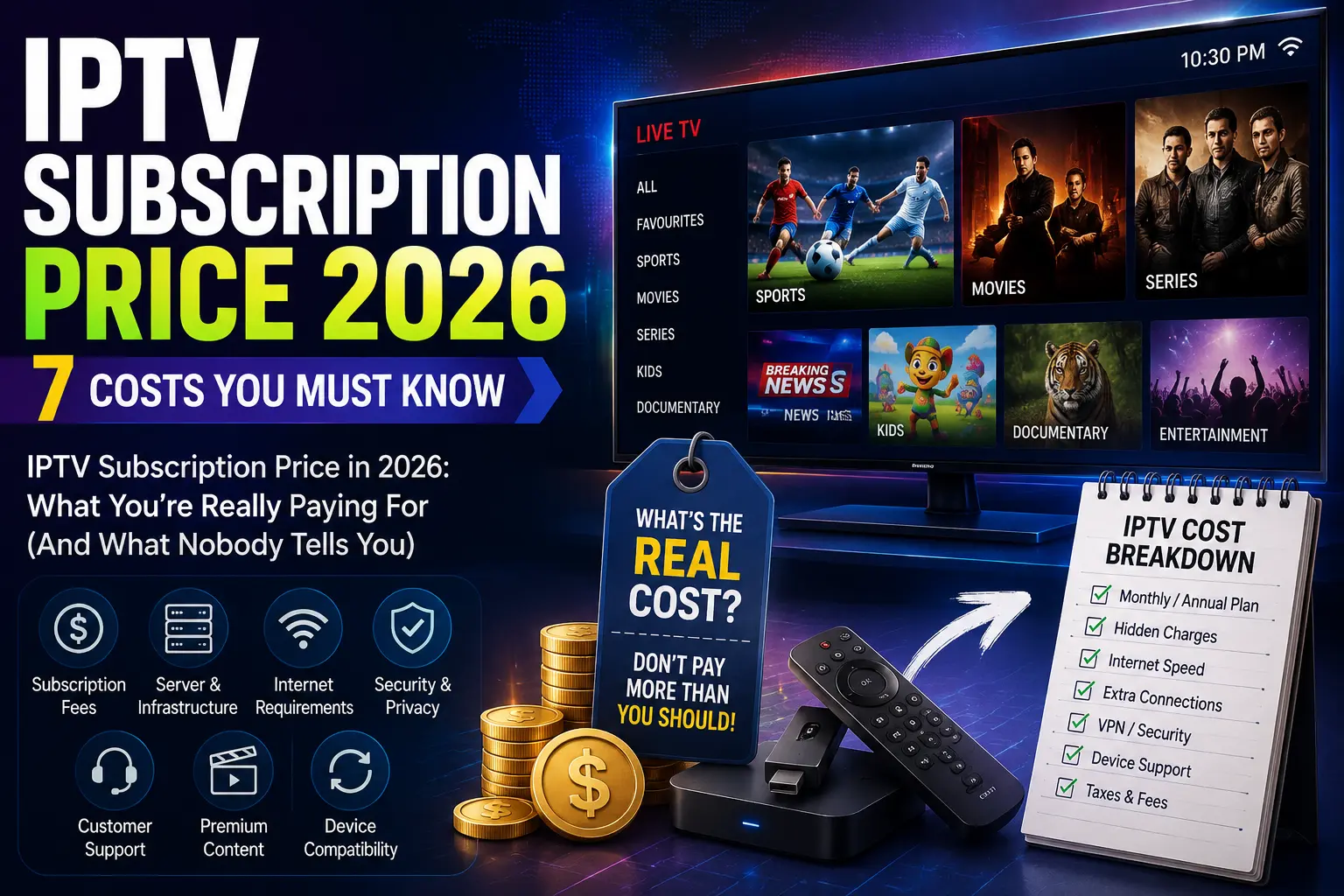
IPTV Subscription Price in 2026: What You’re Really Paying For (And What Nobody Tells You)
Right, let’s talk numbers. If you’ve spent even ten minutes searching for an IPTV subscription price, you’ve probably noticed something strange. One site quotes you £8 a month. Another wants £45. A third throws around “lifetime access” for £120 and expects you to just trust that. So which one is actually reasonable?
I’ve spent years around the reseller and subscriber side of this industry, and I can tell you the honest answer isn’t a single number. It’s a range, and understanding why that range exists is the difference between getting a solid service and getting burned within three weeks. This piece breaks down what actually drives an IPTV subscription price, what a fair range looks like, and where the red flags usually hide.
What Actually Determines an IPTV Subscription Price
Here’s something a lot of comparison sites skip over. The price you’re quoted isn’t just a number someone made up. It reflects server capacity, content sourcing arrangements, channel count, streaming quality, and in some cases how many resellers are sitting between you and the original infrastructure.
Think of it like a supply chain, though not every service is built this way. In some reseller models, a provider builds server infrastructure, then sells access to resellers, who sell to sub-resellers, who eventually sell to you. Every layer in that chain can add a small margin. That’s not automatically a scam, it’s just how some parts of the market operate. But it does mean two sellers offering what looks like the same service can charge quite differently depending on how many hands the connection passed through.
Server quality matters more than people realize too. A provider running on cheap, overloaded servers can undercut everyone on price and still turn a profit, right up until the buffering starts during a Saturday football match.
A Realistic Look at Pricing Tiers
Let’s get specific, because vague ranges don’t help anyone budgeting for this. I put together a quick breakdown below so you can see how tiers usually shape up across the UK and European markets right now.
That £6 to £10 tier is the one to treat with a bit of caution. It’s not that cheap providers are automatically dishonest, some run genuinely tight operations and pass real savings on. But pricing that low can sometimes reflect lower server capacity, limited support, fewer features, or other compromises, so it’s worth testing the service before committing. You’ll notice it most during big events, when everyone’s streaming at once and the picture starts stuttering right when you don’t want it to.
| Price range | What you may get | What to watch for |
|---|---|---|
| £6–£10 | Basic, low-cost packages | Reliability, support quality, overloaded servers |
| £12–£20 | Mid-range packages | Compare features and support response times |
| £20–£35 | Larger or premium packages | Higher price doesn’t automatically mean better quality |
| £35+ | Premium packages with add-ons | Verify what specifically justifies the extra cost |
Anything well above £35 a month for a standard package, without added extras like sports bundles or multiple connections, is worth a second look too. At that point you’re either paying for something genuinely premium, or you’re paying reseller markup stacked on reseller markup.
Why Two Sellers Can Quote Such Different Numbers
I’ll be honest with you, this used to confuse me too when I first started paying attention to the reseller side of the business. You’d see the exact same channel list, sometimes the exact same EPG data, being sold at noticeably different prices by two separate sellers.
Here’s what’s often happening. Some IPTV reseller businesses buy access in bulk from a main provider, then set their own retail price on top. A reseller running lean, with low overhead and a smaller customer base, might genuinely need less margin. A reseller running paid ads, a large support team, and a polished website has to recover those costs somewhere, and that somewhere shows up in what you pay.
If you’re curious about how that reseller structure works from the business side rather than the buyer side, we’ve written a detailed breakdown here.
How to Start an IPTV Reseller Panel Business in 2026 → /iptv reseller panel business
What You’re Really Paying For
Let’s break this down properly, because price on its own doesn’t tell the full story. A few factors quietly shape what fair pricing actually looks like.
Server infrastructure is the big one. Dedicated servers cost real money to run, and that cost gets baked into what you pay. Shared or overloaded servers keep prices artificially low but hand you the buffering problem eventually.
Channel and VOD library size plays a role too, though not as much as people assume. A service with 8,000 channels isn’t automatically better than one with 3,000 if half of those extra channels are dead links or duplicated feeds under different names.
Support responsiveness matters more than most buyers expect going in. When your connection drops mid match and nobody answers a message for six hours, whatever you paid suddenly feels a lot less reasonable, regardless of the number on the invoice.
A Quick Story From My Own Search
A friend of mine went looking to buy best IPTV subscription options a few months back, and he did exactly what most people do. He sorted every site by price, low to high, and picked the third cheapest option because it “seemed safe, not the absolute bottom.”
Three weeks in, half the sports channels were freezing every weekend. He’d saved maybe £4 a month compared to a mid tier option, and lost far more than that in frustration. I’m not saying cheap always means bad. I’m saying price alone tells you almost nothing about what you’re actually going to experience once you’re using the service.
Is a Higher Price Always Better?
Not necessarily, and this is where a lot of comparison articles get lazy. Paying more doesn’t automatically buy you stability. Some premium priced services are simply better marketed, not better built.
In my experience, reliability tends to track more closely with server transparency (can the seller tell you where their infrastructure is hosted), a consistent uptime record, and how a provider handles refunds or credit issues, than with price alone. None of those things require top dollar, but very few of them show up at the absolute bottom of the market either.
So where does that leave you? Somewhere in the middle, generally, unless you’ve done the homework to verify a specific provider’s track record.
A Simple Checklist Before You Commit
Before paying for any IPTV service, run through this:
- Check if the seller offers a trial or short term test period
- Ask directly how many connections their servers typically handle
- Look for independent reviews outside the seller’s own website
- Confirm what happens if channels go down, is there a replacement policy
- Compare the IPTV subscription price against at least two other sellers offering similar specs
None of these steps take more than a few minutes, and together they’ll save you from most of the common disappointments.
Free Trials, Refund Policies, and What They Actually Tell You
A seller willing to offer a genuine free trial is usually more confident in their service. That’s not a hard rule, but it’s a reasonable signal. If a provider refuses any kind of trial and pushes hard for immediate payment, ask yourself why.
Refund policies matter just as much. Ofcom’s general guidance on consumer rights around digital subscription services in the UK still applies in principle to how legitimate subscription businesses should handle cancellations and refunds, and it’s worth knowing your basic rights before you commit to any provider.
Worth being precise here too. IPTV itself is simply a delivery technology, streaming television over an internet connection rather than an aerial or satellite dish. Whether a specific service is operating properly comes down to whether it has the rights to distribute the content it’s offering, and that varies enormously from one provider to the next.
How Currency and Region Affect What You Pay
If you’re comparing pricing across different regions, remember exchange rates shift things more than people account for. A service priced in USD might look cheaper than a UK based one until you factor in the current exchange rate and any payment processing fees your card provider adds.
UK based sellers, including established UK iptv reseller operations, sometimes price slightly higher specifically because they handle local payment methods, local support hours, and in some cases faster server routing for UK based viewers. That convenience has a cost, and it’s not always unreasonable.
Common Mistakes People Make When Comparing Prices
Isn’t it strange how often people compare price without comparing anything else at all? It happens constantly. Someone finds the cheapest listing, assumes all providers are functionally identical, and gets surprised when the experience doesn’t match expectations.
Another mistake is assuming a lifetime deal is automatically the smarter long term choice. Lifetime pricing can work out well, but it also depends entirely on the provider staying in business and keeping servers maintained for years. A monthly IPTV subscription price gives you the flexibility to walk away the moment quality drops, which lifetime deals simply don’t offer.
Setting a Realistic Budget
If you’re weighing up what to spend, think in terms of what reliability is worth to you personally. Missing the second half of a match because of buffering costs you something too, even if it’s not measured in pounds.
For many UK households, £12 to £20 a month is a reasonable mid range benchmark for comparing standard packages with decent support. From there, you adjust based on how many devices you need connected and whether sports content is a priority.
Final Thoughts
There’s no single correct IPTV subscription price, and anyone telling you otherwise is oversimplifying a market that genuinely varies by server quality, support standards, and region. What you can control is how carefully you check before you commit. Ask for a trial, compare at least two or three sellers, and treat an unusually low price as a question rather than a bargain.
Get that part right, and the price you settle on will actually reflect the service you receive, not just the number on a landing page.
Frequently Asked Questions
What is a fair IPTV subscription price for a UK household in 2026?
For many UK consumers, £12 to £20 a month is a reasonable mid range benchmark for a standard package with decent support and stable servers. Pricing below that range often signals overloaded infrastructure, while pricing well above it doesn’t automatically guarantee better quality. The safest approach is comparing at least two or three sellers before committing.
Why do IPTV subscription price quotes vary so much between sellers?
Different sellers sit at different points in the supply chain, and in some reseller models each layer adds its own margin. Server quality, support staffing, and marketing costs also factor into the final number. Two services with similar channel lists can still land at very different price points for these reasons.
Should I avoid the cheapest IPTV subscription price I can find?
Not automatically, but treat it with caution. Extremely low prices usually mean the provider is cutting corners somewhere, most commonly on server capacity. A short trial period is the best way to test whether a cheap option actually holds up.
Is a lifetime IPTV deal better value than a monthly plan?
It depends on how confident you are in the provider’s long term stability. Lifetime deals can save money if the seller stays reliable for years, but a monthly plan lets you leave immediately if quality drops. For anyone new to a provider, starting monthly is the lower risk choice.
Do UK based IPTV resellers usually charge more than international ones?
Sometimes, yes, and it’s often tied to local payment support, UK support hours, and server routing aimed at UK viewers. That difference isn’t automatically bad value, since it can mean fewer connection issues for local users. It’s still worth comparing what you’re getting for the extra cost.