Book Appointment Now
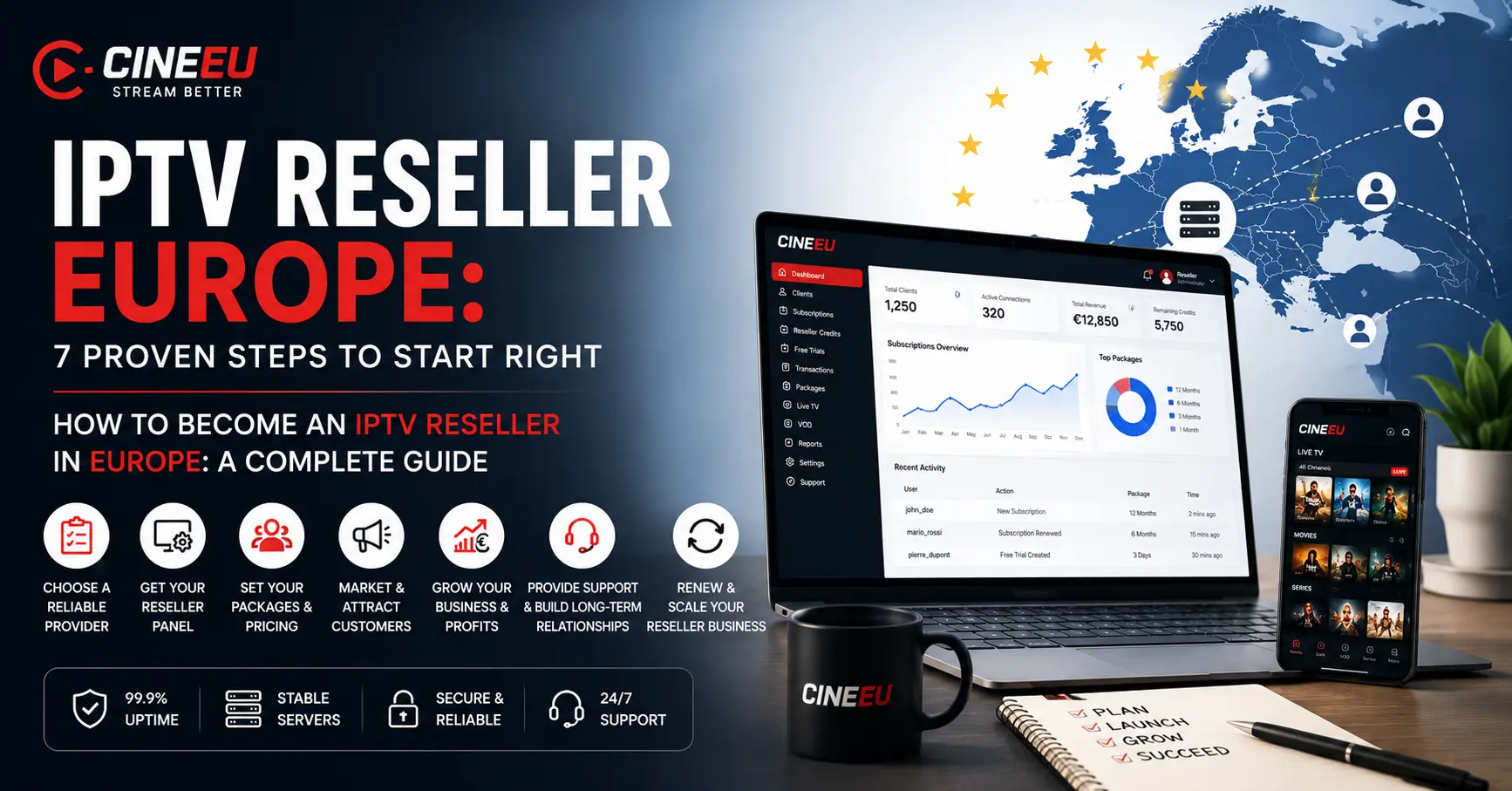
How to Become an IPTV Reseller in Europe: A Complete Guide
I got my first message from a would-be IPTV reseller Europe at nearly midnight, asking whether he could realistically start with fifty euros and a laptop. He could, technically. Whether he should have started that way is a different question entirely, and it’s the one this article is really about.
There’s a lot of noise around this industry. Forums full of half-truths, Telegram groups selling “guaranteed” panels, and YouTube videos that make the whole thing sound like printing money in your sleep. None of that is quite accurate, but the underlying opportunity is real, and Europe happens to be one of the most active regions for it. Let’s get into what starting an IPTV reseller business in Europe actually involves, without the hype.
What an IPTV Reseller Actually Does
An IPTV reseller sits between a panel provider (or a white label IPTV platform) and the end customer. You’re not building streaming infrastructure yourself. You’re buying access in bulk, usually through IPTV credits, and reselling subscriptions to individual users at a markup.
Think of it a bit like a mobile phone MVNO. Virgin Mobile didn’t build its own cell towers in the early days; it leased network capacity and sold it under its own brand with its own pricing and support. That’s essentially the shape of an IPTV reseller business, minus the regulatory scale.
Your job as a reseller boils down to three things: sourcing reliable access through an IPTV panel, managing your credits sensibly, and keeping customers happy enough to renew month after month. It sounds simple written out like that. In practice, the third part is where most people trip up.
Why Europe Is Such a Live Market Right Now
Europe has a fragmented broadcasting landscape. Someone in Lisbon wants different content than someone in Warsaw, and traditional cable or satellite packages rarely serve either of them well at a reasonable price. That fragmentation is exactly the gap an IPTV reseller business can fill.
There’s also a measurable shift happening. Ofcom’s Media Nations 2026 report found that only 70% of people in the UK watched traditional broadcaster content for at least 15 minutes a week in 2025, down from 73% in 2024 and 78% in 2022, with declines recorded across every age group. Similar erosion of traditional pay-TV loyalty shows up across the continent, and it’s exactly the gap flexible, month-to-month IPTV subscriptions are stepping into.
Is that demand guaranteed to stay this strong forever? Probably not at this exact pace, but the direction of travel is clear. None of this means the market is easy money. It means the demand exists, and an IPTV reseller who treats the business seriously, with decent uptime and real customer service, has room to build something sustainable.
White Label IPTV vs Building Something From Scratch
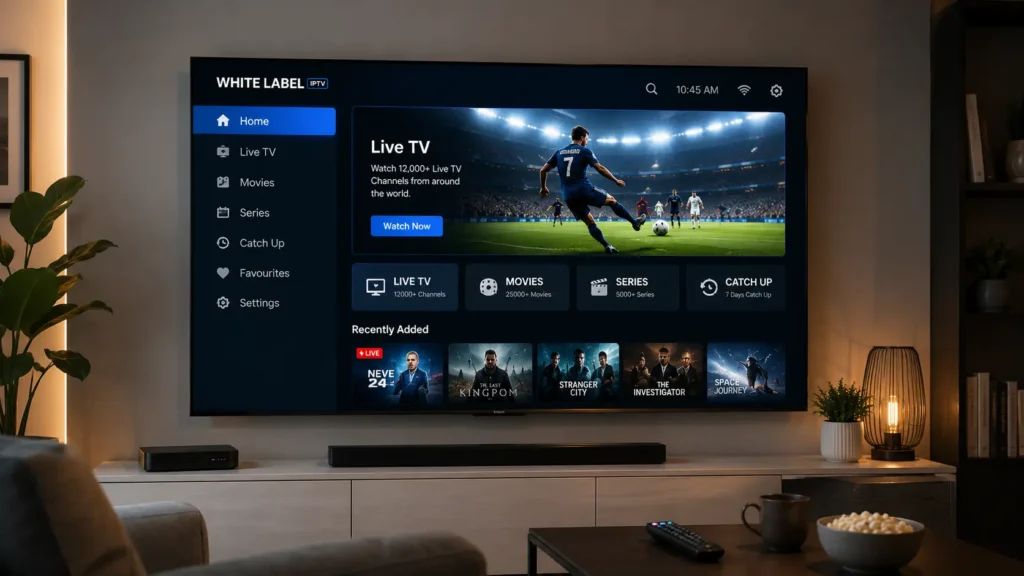
This is usually the first real decision a new reseller has to make. White label IPTV means you’re taking an existing platform, sometimes with your own branding, app, and portal, and operating it as if it were your own product. You’re not writing code or managing servers.
Building from scratch means sourcing your own streams, setting up your own middleware, and handling infrastructure directly. It’s a completely different scale of operation, closer to running a small telecom than reselling a service.
For almost everyone starting out, white label IPTV is the sensible route. It removes the technical burden and lets you focus on sales, pricing, and customer retention, which is where the actual business skill lives. Building from scratch only makes sense once you already have hundreds of active customers and the volume to justify the operational overhead.
Here’s a quick side by side to make the trade-off clearer.
| Factor | White Label IPTV | Build From Scratch |
|---|---|---|
| Startup cost | Low, tied to IPTV credits | High, infrastructure and licensing |
| Technical skill needed | Minimal | Significant |
| Control over uptime | Dependent on provider | Full control |
| Best suited for | New and mid-size resellers | Established operators with volume |
IPTV Credits and How Panels Really Work
IPTV credits are essentially your currency inside a reseller panel. You buy a bundle of credits from your provider, and each credit typically activates or renews one customer subscription for a set period, usually a month. Buy a thousand credits, and you’ve effectively pre-purchased a thousand months of service to sell on.
Panels vary in how generously they price these bundles. Buying in larger volume almost always brings the per-credit cost down, which is exactly why so many resellers try to grow their customer base quickly rather than staying small and stagnant. There’s a real incentive to scale once you’ve proven the model works for you.
Where new resellers get caught out is credit management. It’s easy to burn through IPTV credits by testing lines yourself, offering too many free trials, or under-forecasting renewals. Keep a simple spreadsheet tracking credits in versus credits spent, at minimum, until you’re comfortable enough to justify a proper CRM.
Choosing an IPTV Panel That Won’t Let You Down
Not every panel is worth your time, and this is genuinely the decision that makes or breaks the business. A shaky IPTV panel with frequent buffering or downtime will cost you customers faster than any marketing effort can replace them.
What should you actually look for?
- Consistent uptime with some form of published or demonstrable track record
- Responsive support, ideally with a real human behind it, not just a bot
- Flexible IPTV credits packages that scale as your customer base grows
- A reseller dashboard that’s genuinely usable, not an afterthought
- Clear documentation on device compatibility, including Smart TV apps, Fire Stick, and MAG boxes
Ask any provider for a trial period before committing real money. A panel that won’t offer even a short test run is telling you something, and it’s rarely something good.
The Legal Grey Zone Nobody Wants to Discuss
I won’t pretend this part is comfortable to write, but a serious editorial piece on IPTV reseller Europe has to address it honestly. Content licensing across European broadcasting is complex, and the legal status of any given IPTV panel depends heavily on where its streams actually originate and whether the underlying rights holders have authorised redistribution.
Some providers operate with proper licensing arrangements for the content they offer. Others don’t, and that distinction matters more than most reseller guides admit. As a reseller, you’re rarely in a position to audit a provider’s licensing chain yourself, which means the responsibility of choosing a legitimate white label IPTV partner falls squarely on you.
The scale here isn’t abstract. A Bournemouth University study for AAPA put European losses from illicit IPTV at roughly €3.2 billion, with usage notably higher among 16 to 24 year olds, at 5.9 million users in that age group alone. Enforcement has escalated to match it. In November 2025, Europol’s Operation Kraken dismantled the infrastructure behind one of Europe’s largest illegal IPTV networks, arresting 11 operators across Spain, Portugal, and the Netherlands, in a network that served 4.5 million subscribers and generated an estimated €250 million a year.
That’s the environment any IPTV reseller is operating in, whether they realize it or not. That doesn’t mean every IPTV reseller is operating illegitimately. It means the smart move is treating provider selection as a compliance decision, not just a technical one, and steering clear of any panel that can’t explain where its content comes from.
how to vet an IPTV panel provider → /iptv panel providers
Pricing Your Service for European Customers
Pricing an IPTV reseller offer is part psychology, part arithmetic. Your IPTV credits cost sets the floor, but the ceiling is whatever your local market will actually pay without shopping around for a cheaper alternative.
Western European customers, broadly speaking, tolerate higher price points than customers in parts of Eastern Europe, where competition among small resellers is fierce and margins get squeezed fast. A monthly subscription that feels perfectly reasonable in Germany might struggle to find takers in Romania at the same price.
A few practical habits help here:
- Build tiered packages, such as one month, three months, and twelve months, with the longer terms discounted to encourage upfront commitment
- Keep a close eye on what competing IPTV reseller pages are charging in your target country
- Don’t race to the bottom on price. A customer who churns after two months because service quality was cut to match a low price isn’t a customer worth keeping
Your margin is the gap between your IPTV credits cost and what customers actually pay, and that gap needs to survive refunds, support time, and the occasional dead line. Price too thin and one bad week wipes out a month of profit.
Getting Your First Paying Customers
Nobody wakes up on day one with a queue of customers, and any reseller guide that suggests otherwise is selling something. Early growth for an IPTV reseller almost always comes from a mix of personal network, niche community presence, and word of mouth once the first few subscriptions prove reliable.
Facebook groups and local Telegram or WhatsApp communities built around expat populations, sports fans, or specific diaspora groups tend to convert well, because trust travels faster in smaller, tighter circles. A recommendation from someone’s cousin carries more weight than any advert.
What if your first ten customers are genuinely happy? Ask them, plainly, for a referral. It costs nothing and it’s more effective than most paid marketing a brand new IPTV reseller could afford anyway. Build a simple landing page describing your packages clearly, keep your support response time fast, and let consistency do the rest.
Mistakes New Resellers Keep Making
A few patterns show up again and again with new IPTV reseller businesses, and most of them are avoidable with a bit of foresight.
- Underpricing out of fear of losing customers to competitors, which erodes margin until the business isn’t worth running
- Ignoring credit forecasting, then scrambling to top up IPTV credits mid-month when renewals hit
- Choosing a panel purely on price without checking uptime history or support responsiveness
- Skipping any kind of written terms with customers, which makes refund disputes messy
- Treating white label IPTV branding as an afterthought instead of something that builds trust
None of these mistakes are fatal on their own. Stacked together, they’re usually why a promising reseller business quietly fizzles out within a year.
Before You Launch: A Quick Checklist
- Choose a white label IPTV or panel provider with a verifiable uptime track record
- Test the service yourself for at least a week before selling it to anyone
- Buy a starter batch of IPTV credits sized to your realistic first month, not your optimistic one
- Set clear pricing tiers before your first customer conversation, not during it
- Draft simple terms covering refunds, trial limits, and support hours
- Set up a basic tracking sheet for credits, renewals, and customer contact details
Frequently Asked Questions
Is becoming an IPTV reseller in Europe legal?
It depends entirely on the panel and content source you choose to work with. Some providers hold proper licensing for their content, while others operate in a legal grey area, so due diligence on your specific provider matters more than any general answer. Treat provider selection as a compliance decision, not just a business one.
How much does it cost to start an IPTV reseller business?
Starting costs vary widely depending on the panel and your chosen IPTV credits package, but many providers offer entry bundles at a modest price. Your real cost comes from ongoing credit purchases as your customer base grows, not the initial setup. Budget conservatively for your first few months.
What’s the difference between white label IPTV and a standard reseller panel?
A standard panel lets you resell access under the provider’s existing branding, while white label IPTV lets you present the service under your own name, app, and portal. White label options generally cost more but build stronger customer trust over time. Many resellers start standard and upgrade to white label as they scale.
How do IPTV credits actually work day to day?
Each credit generally activates or renews one customer’s subscription for a set period, most often a month. You purchase credits in bulk from your provider and draw them down as customers sign up or renew. Careful tracking prevents you from running short during a busy renewal week.
Which countries in Europe are best for starting an IPTV reseller business?
Western European markets like Germany, France, and the UK tend to support higher price points, while Eastern and Southern European markets often have larger customer volumes at lower margins. The right market depends on your pricing strategy and where your personal network or niche community already exists. Testing in one country before expanding usually works better than spreading thin from day one.