Book Appointment Now
Choosing an iptv reseller panel provider without getting burned
A few winters back, a friend of mine, let’s call him Dan, decided to make some money on the side selling streaming subscriptions. He found an iptv reseller panel provider through a forum advert, sent over three hundred pounds for credits, and received a login to a dashboard that looked every bit the professional operation. By the following Saturday the panel was down, the support chat had gone silent, and Dan was explaining to his first ten customers why their screens had frozen at kick-off.
That story repeats itself more often than you’d expect. Put simply, an iptv reseller panel provider is the wholesaler behind the curtain: a company that hands you a web-based panel, a stack of subscription credits, and the technical plumbing to sell live channels and video-on-demand under your own name. You deal with customers, pricing, and marketing. They deal with servers, streams, and the unglamorous work of keeping everything upright. When the partnership works, it’s a tidy little business. When it doesn’t, you learn the ugly truth of this trade in a hurry: your customers blame you, not the faceless operation upstream.
So how do you spot the difference before money changes hands? After fifteen years of writing about this industry, and after talking with dozens of resellers about what went right and what went badly wrong, I’ve noticed the same warning signs surfacing again and again. This article walks you through them, along with the technical details, the pricing maths, and the device landscape you’ll need to understand before you commit to any iptv reseller panel provider.
What an iptv reseller panel provider actually does behind the scenes
Strip away the jargon and the role is simple. A provider buys bandwidth and server capacity in bulk, maintains the streams and the content library, and resells access in the form of credits. Each credit typically converts into a one-month subscription for one customer. You log into your panel, create an account for a buyer, burn a credit, and hand over their login details or playlist.
Most panels run on one of two bits of software. Xtream UI, and its actively maintained successor XUI.One, power the majority of dashboards you’ll encounter, offering customer management, line creation, and reseller hierarchies. Ministra, formerly known as Stalker, is the other heavyweight, particularly popular where MAG-style set-top boxes are common. The lineage matters here. When the original Xtream Codes hosted service was taken down in 2018, an event Europol publicised and tech outlets covered for weeks, the panel software survived as open-source forks. That’s why the same dashboard keeps reappearing under different brands, and why the real difference between providers is the infrastructure behind the panel, not the panel’s appearance.
A competent iptv reseller panel provider will support the formats your customers actually ask for: M3U playlists for apps like TiviMate, the Xtream Codes API for username-and-password login, MAG portal URLs for older boxes, and Enigma2 scripts for satellite receiver enthusiasts. If a provider only offers one format, you’re quietly excluding a slice of your market before you’ve sold anything.
What’s worth understanding is where the responsibility line sits. If the streams buffer during a big match, your provider fixes it, but you take the angry message. If a customer can’t log in at midnight, you’re the one answering. That dynamic shapes everything else in this article, because the whole game is choosing a partner reliable enough that you rarely have to say sorry.
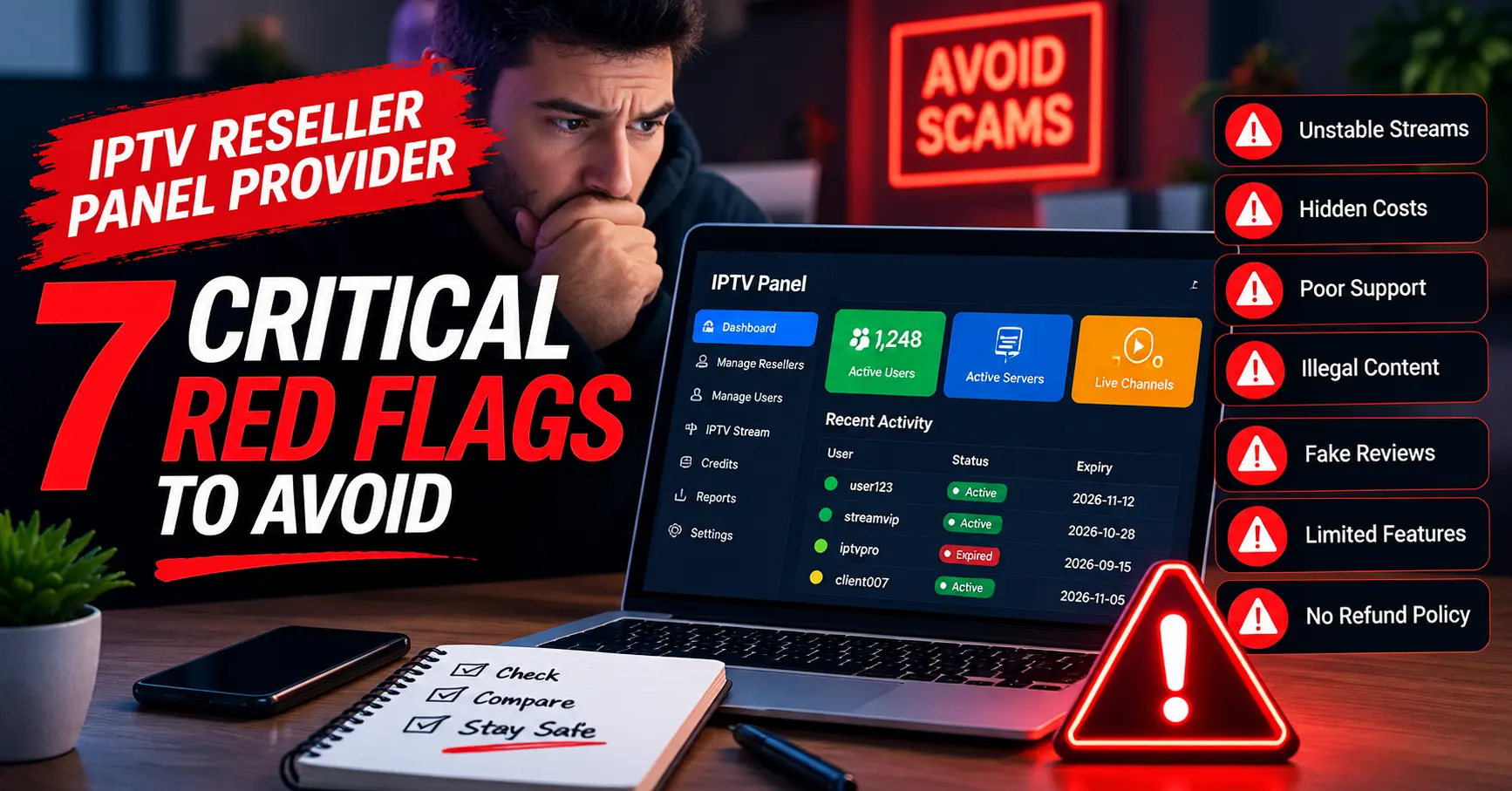
Seven red flags when choosing an iptv reseller panel provider
Ask any seasoned reseller where they went wrong and they’ll rarely blame the technology. They blame the choice of partner. Here are the seven warning signs I now tell every newcomer to treat as deal-breakers, not details.
1. No trial credits, no exceptions
Every reputable iptv reseller panel provider will sell you a small trial pack or a handful of test credits before you commit real money. It’s a trivial cost to them and a huge confidence signal to you. If a provider demands a minimum order of several hundred pounds up front while offering no way to test the streams, ask yourself why the product can’t survive inspection.
2. Nobody knows who owns it
Plenty of good operators in this space keep a low profile, and some discretion is understandable given the nature of the service. But there’s a difference between quiet and a complete absence of track record. Search the provider’s name plus the word “review” in places like Reddit’s IPTV communities or the discussion threads that Cord Cutters News readers frequent. If you find nothing at all, that’s not reassuring; it usually means the brand is either brand new or has burned its reputation and rebranded.
3. “Lifetime” pricing
Nobody can sell you a lifetime subscription to anything that carries ongoing server costs. When a provider advertises lifetime panels or lifetime credits at a discount, you are not buying a deal; you are funding their exit. Monthly credit systems with honest expiry terms exist because servers cost money every single month. Any iptv reseller panel provider offering permanence is telling you, in writing, that the maths doesn’t need to work. Does that sound like a business or a lottery?
4. One payment method, and it’s irreversible
Crypto-only payments are common in this industry, and on their own they don’t prove anything bad. Reversible payment methods cost a provider a small fortune in fraud, so many insist on crypto for sound reasons. The red flag appears when crypto is the only option and every other warning sign on this list is present too. What you want is a provider with an established payment history, a consistent track record among existing resellers, and zero stories of money vanishing into the void.
5. No API documentation
Modern reselling runs on automation. Your panel should expose an API so your website can create trials, extend lines, and check status without you touching a keyboard. The Xtream Codes API ecosystem makes this straightforward, and any serious iptv reseller panel provider will hand you documentation on day one. If the answer to “do you have an API?” is a shrug, you’ll be running a manual shop in an automated market, and your competitors will undercut you while they sleep.
6. “Never freezes, ever”
All streaming buffers sometimes. Servers get attacked, peaks happen, transcoders need maintenance. A provider promising perfection is either lying or has so few customers that nothing has been stress-tested yet. I’d rather hear “here’s our uptime for the last year and here’s what we do when a channel goes down” than any promise of immortality. Honesty about failure is strangely the most reliable quality signal in this business.
7. Credit terms that trap you
Read the fine print on how credits expire and how sub-resellers work. Some panels quietly burn your unused credits after 30 days. Others let you create sub-resellers but claw back their customers if the sub leaves. None of this is automatically bad, but you should know the rules before you build your pricing around them, not after.
The technical checklist most resellers skip
When you evaluate an iptv reseller panel provider, the sales pitch will cover channel counts and video quality. The things that actually determine your day-to-day life sit one level deeper. Here’s what I’d verify with test credits before spending properly.
-
EPG quality: a guide that shows “no information” for half the channels will generate more complaints than any buffering ever could.
-
VOD depth and turnover: films and box sets matter as much as live sport to many buyers, and a stale library is hard to sell.
-
Catch-up and recording: some panels offer 24 to 72 hour catch-up on popular channels. Customers notice this feature, and it quietly justifies higher prices.
-
Multi-connection rules: can one customer watch on two devices at once? Is it priced sanely? Families ask about this before anything else.
-
Stream stability at peak: test on Saturday afternoon and during a major event, not on a quiet Tuesday morning. That’s when overloaded infrastructure shows its face.
-
Panel responsiveness: the dashboard itself should load quickly and create lines without timing out. You’ll live in this interface.
best iptv subscription features compared → /best iptv subscription
One more point that rarely gets mentioned. Check whether the provider communicates during outages. The difference between a ten-minute outage and an angry weekend is often just a Telegram message saying “we know, we’re on it”. Providers who communicate keep resellers. Providers who vanish lose them, no matter how good the streams are the rest of the time.
The maths nobody shows you: a working reseller P&L
The romance of this business is passive income. The reality is a spreadsheet. Let me show you the simple version I encourage every prospective reseller to build before they sign with any iptv reseller panel provider.
Say you buy credits at £2.50 each and sell monthly subscriptions at £10. Gross margin per customer is £7.50, which sounds generous until you subtract the costs that don’t announce themselves. Payment processing in this niche is awkward, so budget £1 per customer for transaction friction. Support time, even at a modest ten minutes per customer per month, is real labour. Then there’s churn.
Churn is the number that decides whether you make money at all. A typical reseller loses 5 to 10 percent of subscribers each month. At 8 percent monthly churn, the average customer sticks around for roughly twelve and a half months, so your £7.50 margin becomes about £94 in lifetime gross profit, minus the overheads above. Your break-even point, if you’ve spent £250 on trial credits, tools, and a simple website, arrives around your fortieth sale. That’s month two or three for a focused reseller and month never for a casual one.
Here’s the monthly picture at steady state:
| Item | Amount |
|---|---|
| Subscribers (month 6) | 120 |
| Revenue at £10/month | £1,200 |
| Credit cost at £2.50 each | £300 |
| Payment friction | £120 |
| Tools, hosting, misc | £40 |
| Net profit | £740 |
Nothing in that table is exotic, but most newcomers never write it down. They sign with the first iptv reseller panel provider that offers cheap credits and discover three months later that cheap credits don’t compensate for a churn rate their provider’s instability caused.
Why churn matters more than margin
New resellers obsess over buying credits fifty pence cheaper. Experienced ones obsess over keeping subscribers an extra month, because retention compounds while discounts don’t. If better upstream quality cuts your churn from 10 percent to 6 percent, your average customer lifetime jumps from ten months to nearly seventeen. That’s more than sixty pounds of extra lifetime revenue per customer, which dwarfs any plausible saving on credit prices. When you compare providers, weight stability metrics far above unit cost. Your future self will thank you at month nine.
smart iptv, Firesticks, and the kit your customers plug in
Your customers don’t experience your panel. They experience a ten-pound app on a forty-pound stick. Knowing that landscape matters more than most resellers expect.
Amazon’s Fire TV Stick dominates the entry level, usually running TiviMate or IPTV Smarters. Android boxes fill the mid-range. Samsung and LG televisions bring their own app stores, and that’s where smart iptv enters the conversation. The smart iptv app has been a fixture on smart TVs for years precisely because it turns a television’s built-in store into a one-install IPTV client, and a large slice of mainstream buyers, the ones who’d never plug in an external box, search for it by name.
Why does this matter to you as a reseller? Because setup friction kills sales that advertising wins. If your iptv reseller panel provider hands you clean M3U links and Xtream Codes login details, you can walk a smart iptv user through installation in five minutes. If the provider’s streams only cooperate with one specific app on one specific device, every sale becomes a tech support call.
The practical advice I give people is straightforward: test your provider’s lines on a Firestick, on an Android phone, and on at least one major-brand smart TV. That trio covers the overwhelming majority of your future customers. If the streams behave identically across all three, you’ve found a provider worth keeping.
What people really mean when they search “buy premium iptv”
Spend time in this industry’s search data and you’ll notice something interesting. Consumers type “buy premium iptv” when they want the good stuff: stable 4K sport, full VOD libraries, catch-up, multi-screen. They’ve usually already tried a free playlist from a random forum, watched it die within a week, and decided to pay for reliability.
That’s your market. The phrase signals a buyer who has been burned once and is now comparing providers with a sceptical eye. Which raises the obvious question for a reseller: does the iptv reseller panel provider behind your brand actually deliver what these buyers are hunting for? Your marketing can borrow the language of “premium”, but if the underlying product buffers every Saturday, those sophisticated buyers will churn faster than the freebie hunters ever did.
There’s also a positioning lesson here. When someone searches for the best iptv subscription, they’re comparing the retail end of the market, the polished websites with instant trials and tidy branding. The resellers who win that comparison aren’t necessarily the ones with the cheapest credits upstream.
They’re the ones whose provider gives them the raw materials of trust: consistent quality, quick replacements when a line breaks, and honest answers when something goes wrong. You can out-market a weak provider for a while. You cannot out-market a weak product forever.
Support, credits, and the operational fine print
Two resellers can sign with the same iptv reseller panel provider on the same day and have wildly different years. The difference is usually operational discipline, so let’s cover the habits that separate the two.
First, never let your credit balance hit zero on a match day. Automated top-ups exist for a reason, and a customer whose line expires during a final will not forgive you because the wholesaler was slow.
Second, track your own numbers independently. Your panel reports one version of churn; your payment records report another. When they diverge, trust your own ledger, and use the gap as a signal about whether your provider’s product is quietly deteriorating.
Third, learn the rhythm of the trade. Major sporting weekends strain every provider on earth. That’s when weak infrastructure fails and when your customers need you most. The resellers who check their panels proactively on those days, rather than waiting for complaints, keep the kind of ratings that attract referrals.
Finally, treat your provider relationship like any other business partnership. The good operators I’ve seen profiled in trade coverage over the years, including the sort of streaming economy reporting TorrentFreak has long documented, succeed because they run real operations with real obligations, not because they found a magic server. Choose accordingly, and revisit the decision every few months rather than assuming yesterday’s good provider is still good today.
Frequently Asked Questions
1. How much does it cost to start with an iptv reseller panel provider?
Most providers offer starter packs between fifty and two hundred pounds, which buys you enough credits to test the service and sign your first customers. Budget separately for a domain, simple website, and payment handling, since those costs land before your first sale. Realistically, you can be trading properly for under three hundred pounds if you choose carefully. The expensive mistakes come from buying large credit bundles before you’ve tested anything at all.
2. Can I create my own sub-resellers under my iptv reseller panel provider?
Many panels support sub-reseller hierarchies, where you sell credits to other sellers at a markup and they handle their own customers. XUI.One handles this well, and Xtream UI based setups usually offer it too. Check the terms carefully, because some providers restrict how deep the hierarchy goes or reclaim sub-reseller customers if the relationship ends. It’s a powerful growth tool when the rules are fair, and a trap when they aren’t.
3. What’s the difference between M3U and the Xtream Codes API for my customers?
An M3U file is a playlist your customer loads into an app, while Xtream Codes API logins let an app fetch channels, VOD, and EPG automatically using a server address, username, and password. Most modern apps prefer API logins because they’re tidier and self-updating. Your iptv reseller panel provider should supply both for every account, so customers can use whichever their device prefers. It’s a small detail that prevents a surprising number of support messages.
4. Why do customers search for the best iptv subscription instead of a reseller?
Because from the outside, buyers see retail brands, not wholesale panels. They compare what your shop presents: price, channel list, trial options, and how quickly you answer messages. Your job as a reseller is to make your offer look like the obvious best iptv subscription in that comparison, with quality from your upstream provider doing the heavy lifting behind the scenes. Presentation wins the click, but delivery keeps the subscriber.
5. How do I know when it’s time to switch providers?
Watch three numbers: monthly churn, complaint volume during peak events, and the share of support tickets your provider actually resolves. If churn climbs steadily for two or three months while your own service stays consistent, the product upstream is degrading. Switching panels is painful but survivable. Slow-rotting quality, watched in silence, is what actually ends reseller businesses.