Book Appointment Now
From Credits to Customers: A Practical IPTV Panel Reseller Playbook
Last spring a friend of mine, a plumber from Leeds, rang me at half past ten on a Sunday night. He’d spent his savings on a bundle of credits from a stranger online, hoping to become an iptv panel reseller by the end of the month. Then the panel went dark, the stranger stopped replying, and forty customers wanted answers.
Nobody warns you about that part, and that’s exactly why I’m writing this. Becoming an iptv panel reseller can be a perfectly reasonable small business, but only if you treat it like one rather than a hustle. I’ve spent fifteen years around telecoms and streaming, and I’ve watched the same avoidable mistakes repeat. Consider this the conversation I wish my friend had before he handed over his money.
What an IPTV Panel Reseller Actually Sells
Strip away the jargon and an iptv panel reseller’s job is simple. You buy access from an upstream iptv service provider, then sell subscriptions to end customers at a higher price. The panel is the dashboard that ties it together, letting you create accounts, set expiry dates and see who has paid.
Think of it like a mobile virtual network operator. Vodafone or EE owns the masts, while a brand such as Lebara or giffgaff rents capacity and looks after the customer. An iptv reseller does something similar with video, which means your real product isn’t channels at all. It’s reliability, plus a human being who answers messages.
So who’s actually buying? Usually households tired of juggling four streaming apps, expats who miss channels from home, and sports fans who want everything in one place. Each group cares about slightly different things. You’ll want to know which one you’re serving before you spend a penny.
Panels vary more than newcomers expect. Some offer sub-reseller tiers, so you can recruit people beneath you, while others include billing modules, branded apps and usage statistics. Cheaper ones give you little more than an account generator and a prayer.
Alongside the panel, you’ll need ordinary business tools. Stripe or PayPal handle payments, and a help desk such as Freshdesk or Zendesk keeps support tidy. None of it is glamorous, yet it separates a business from a side project.
A good iptv panel provider will give you three basics. Those are a stable stream source, a panel that doesn’t crash when you bulk-create accounts, and support that answers within hours. Anything less and you’re the one apologising to customers.
The Maths Behind the Margins
Money first, because it’s where most dreams quietly die. Credits are the currency of nearly every panel. One credit typically buys one month on one connection, and bigger packs bring the unit cost down. Your margin is whatever’s left after everything you forgot to count.
Here’s a worked example with round numbers. Say you buy 100 credits at £2 each, so £200 up front. You sell each subscription at £8 a month, which brings in £800 if every credit sells. That looks like £600 profit, and it isn’t.
Refunds, payment fees, a support inbox that eats your evenings and a simple website all take a bite. Then there’s churn, since some customers leave after month one no matter what you do. Realistically, I’d budget for selling between 60 and 80 percent of your credits in the first quarter. The rest is stock you’ve already paid for.
Does that put you off? It shouldn’t, but it ought to make you careful. A first-time iptv panel reseller who plans for 70 percent sell-through and prices accordingly usually sleeps better than one who assumes every credit is pure profit.
Pricing deserves its own thought. Undercutting everyone is tempting, yet rock-bottom prices attract the customers who churn fastest and complain loudest. Fair pricing with visible reliability tends to build a loyal base.
Cashflow is the quiet killer. You pay for credits now and collect revenue over weeks, so an oversized pack can leave you unable to cover anything else. Start modest, and reorder when you’re down to about 20 percent.
Licensing Is the Question That Decides Everything
I’ll be blunt here, because glossing over this would do you a disservice. IPTV as a technology is entirely legal, and broadcasters such as Sky and BT run it themselves. What isn’t legal is redistributing channels or sports feeds without the rights to do so.
Plenty of cheap panels sit in exactly that grey zone, and cheap is usually the giveaway. Enforcement has stepped up in recent years, with the Alliance for Creativity and Entertainment announcing takedowns of large illegal streaming operations. An iptv panel reseller isn’t always the target, but nobody in the chain is truly invisible.
Ask any prospective supplier plain questions. Who holds the content rights, in which territories, and can they show it in writing? A reputable iptv panel provider will answer without irritation, while one that goes quiet has told you what you need to know.
I’m not a lawyer, and rules differ between countries, so please take proper advice for your own situation. What I can say is that the reseller businesses that last tend to be built on licensed or clearly permitted content. Think niche channel bundles, community channels or free-to-air lineups. They earn less per subscriber, but they don’t vanish overnight.
Data protection matters as well. If you hold customer emails and payment details in the UK or EU, GDPR applies to you however small you are. A short privacy notice and sensible storage habits go a long way.
Contracts are worth reading line by line. Your agreement with the upstream iptv service provider should say what happens during outages, who owns the customer relationship, and how disputes are settled. If it says nothing, that silence is a warning.
How to Vet an IPTV Panel Provider Without Getting Burned
Test It Before You Trust It
Never buy a big credit pack on day one. Ask for a trial account or a small starter bundle, then use it yourself for two weeks. Watch during peak evenings, when weak infrastructure shows itself. Note buffering, guide accuracy and how quickly the panel loads.
Read the Support Signals
Send them a question at nine on a Friday night and see what happens. A slow reply now means a slow reply when your customers are shouting later. Good suppliers run a ticket system or staffed chat, not one anonymous handle. I’d also want a named contact and a clear outage policy.
Ask About the Servers
Where are the servers hosted, and what happens when one fails? Honest suppliers can answer with specifics, such as regions and failover arrangements. Phrases like “premium servers” mean nothing on their own. Details signal a serious operation.
Follow the Money
Pay in a way you can reverse or document. Card payments and proper invoices leave a trail, while crypto-only or gift card requests should make you wary. Genuine businesses have a company name you can check. Any iptv panel reseller who’s been burned once will tell you the same.
Three Supply Models Compared
Not every upstream arrangement looks alike, so here’s a plain comparison.
| Model | Typical cost | Control | Main risk |
|---|---|---|---|
| Wholesale panel credits | Low per unit | Limited | Supplier disappears |
| White-label from a licensed provider | Medium to high | Moderate | Thinner margins |
| Your own platform with licensed content | High upfront | Full | Time and capital |
Wholesale credits are the easiest doorway, which is why most beginners start there. White-label deals cost more but usually come with clearer contracts and branded apps. Building your own is a serious project, and I wouldn’t attempt it until you’ve run something smaller for a year. For an iptv panel reseller, the real trade-off is speed against certainty.
Margins tell a story too. Wholesale credits might offer a 100 percent markup on paper, while a white-label deal might give 40 percent with far fewer headaches. Paper margins and real margins are different animals.
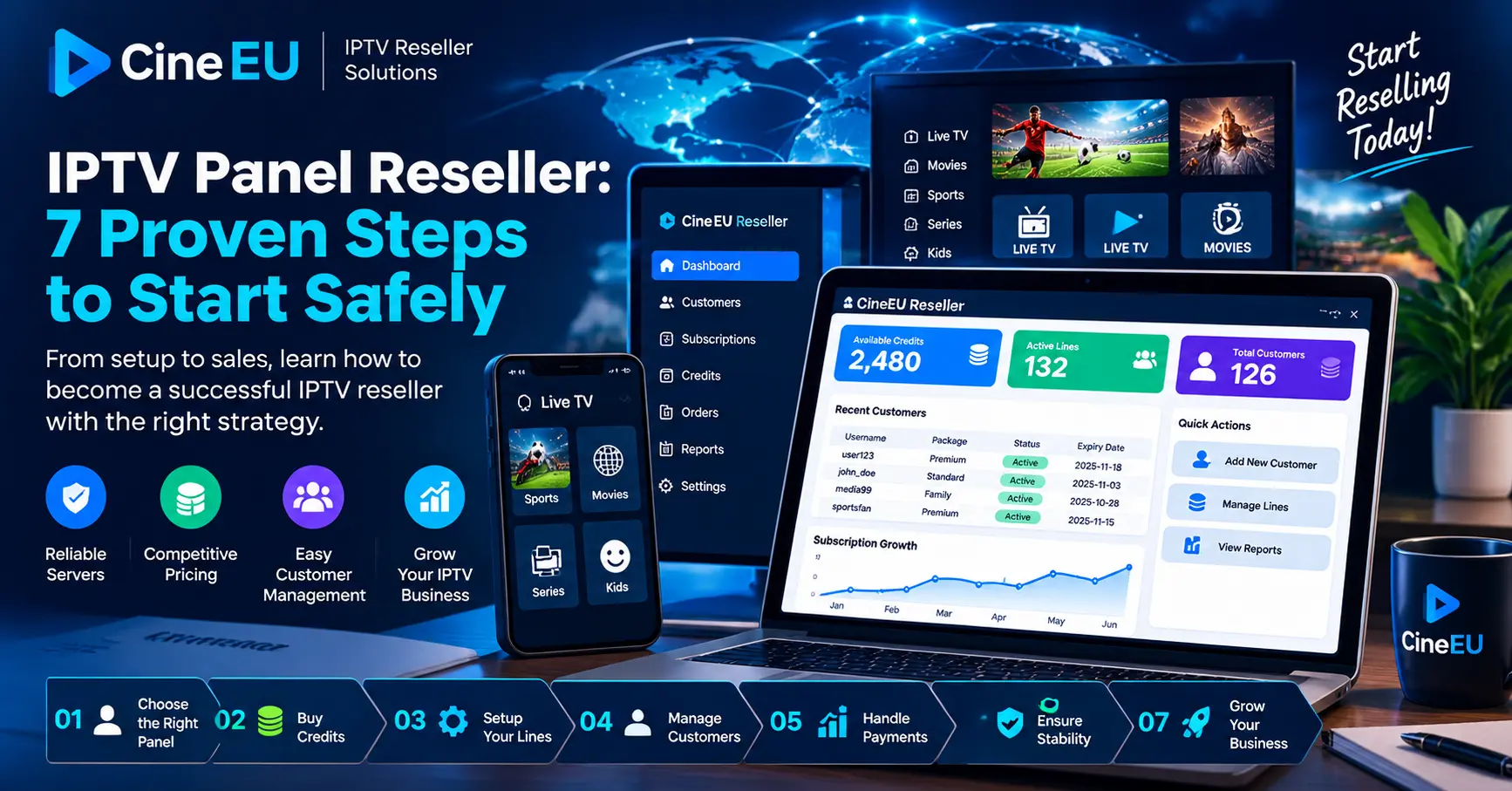
Seven Steps to Launch Your IPTV Panel Reseller Business
Assuming the licensing checks out, this is the sequence I’d follow if I were becoming an iptv panel reseller tomorrow.
- Define your niche. Pick one customer group, such as expats or sports fans, and build everything around them.
- Choose your upstream. Select a vetted supplier after a proper trial, never before.
- Set your pricing. Work out your cost per credit, add fees and refunds, then keep a 30 percent buffer.
- Prepare the storefront. A simple site with clear terms, a refund policy and contact details beats a chaotic chat group.
- Choose payment methods. Use traceable options and keep records from the first sale.
- Run a small pilot. Sign up ten friendly customers and collect honest feedback before advertising.
- Write your support routine. Decide your response times, then stick to them before you market anything.
Notice that marketing comes after the pilot and the support routine, not before. Fast growth on shaky foundations just means more unhappy people asking for refunds.
Onboarding deserves care. Send every new customer a short setup guide, and recommend a dependable player, such as the one covered in choosing an IPTV player app. Ten minutes of guidance now saves hours of support later.
Tax deserves a mention too. In the UK, HMRC expects you to declare trading income once it passes the £1,000 trading allowance, and a proper business will need records anyway. Keep receipts from day one.
Support Wins Customers, and Keeps Them
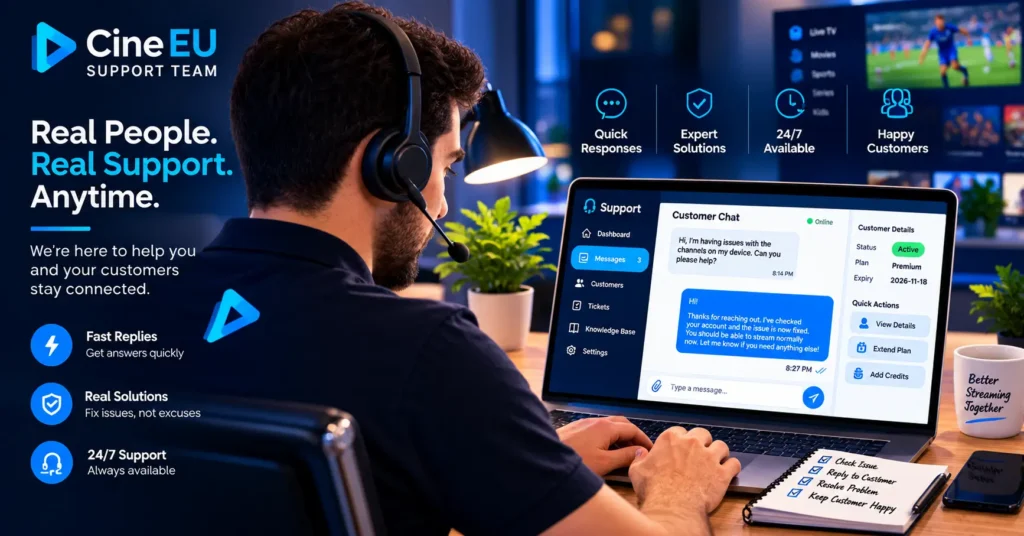
Customers rarely remember the month everything worked. They remember the evening it didn’t, and whether you replied. In my experience, a two-line apology within twenty minutes rescues more subscriptions than any discount.
Ofcom’s Media Nations reports track how UK households watch, and the move towards multiple streaming subscriptions is well documented. That tells you the appetite for bundling is real. It also tells you customers already have plenty of alternatives, and switching costs are low.
Some habits separate the iptv panel reseller who lasts from the one who doesn’t. Keep a status message ready for outages so customers hear from you first. Send renewal reminders three days ahead, and make paying easy. Log every complaint too, because patterns point straight to a weak upstream.
Channels matter. WhatsApp and Telegram are convenient, but a ticket system gives you history, and history gives you patterns. Choose one main channel and publish your response hours honestly.
Policy matters too. A clear refund policy, say seven days for genuine faults, costs you little and reassures nervous buyers.
Confession time: I once ignored a handful of buffering complaints for a week because they seemed unrelated. Then I lost a fifth of my customers in a month. One server region had been failing all along. Since then I treat every complaint as data, and every iptv reseller I respect does the same.
Mistakes I’ve Watched Others Make
After enough years you spot the same patterns. These are the ones that cost people the most.
- Buying huge credit packs to chase a discount before proving demand
- Promising “zero buffering”, which no honest iptv service provider can guarantee
- Running everything through one personal chat account
- Ignoring refunds and terms until the first dispute
- Underpricing to win customers, then having no room to fund support
- Copying another iptv panel reseller’s prices without knowing their costs
None of these is fatal alone. Stack three together, though, and you’ve got a business that runs on stress.
Where This Market Is Heading
Streaming rights are getting pricier and more fragmented, and regulators keep paying attention. That squeezes the cheapest end of the market first. I’d expect survivors to be the ones with clear licensing, honest marketing and support people actually like.
Meanwhile, better apps and smarter guides are raising customer expectations, and a bare playlist link won’t impress anyone in two years. The iptv panel reseller of the near future looks more like a small subscription brand than a middleman. That’s good news if you’re willing to do the unglamorous work.
Then there’s the customer’s side of the story, which I’d encourage you to read in
Stable Streams, Real Support, No Gimmicks: Finding a Premium IPTV Subscription That Lasts → / premium iptv subscription
Seeing what buyers actually value will sharpen every decision above.
If you’re serious, start small, test hard and put your reputation ahead of your margin. Build something your customers would happily recommend to a neighbour. That’s the only marketing that has never gone out of fashion.
Frequently Asked Questions
Q1: What does an iptv panel reseller actually do?
A1: Essentially, an iptv panel reseller buys subscription credits from an upstream supplier and sells access to customers. They use a panel to create accounts, manage expiry dates and track payments. Beyond that, the real work is support, billing and keeping customers informed. It’s closer to running a small subscription service than to flipping goods.
Q2: How much can an iptv panel reseller realistically earn?
A2: Realistically, what an iptv panel reseller earns depends on cost per credit, pricing and how many customers stay. Many beginners overestimate by assuming every credit sells. Planning for 60 to 80 percent sell-through gives a safer picture. Small operations often make modest side income, while larger ones need serious time and systems.
Q3: How do I choose an iptv panel provider?
A3: Trial first. Request a small starter pack, test during peak evening hours and message support at awkward times. Check the payment trail, ask about servers and get licensing answers in writing. Walk away from any supplier who dodges plain questions.
Q4: Is the iptv reseller model legal?
A4: Legality depends on the content rights behind the streams, not the technology itself. Reselling licensed or clearly permitted content is lawful, while redistributing protected channels without rights is not. Rules differ by country, so get proper legal advice before you launch. Asking suppliers for written proof of rights is a sensible first step.
Q5: What should a good iptv service provider offer?
A5: Reliable providers offer stable streams, clear licensing, responsive support and a panel that works smoothly. They also publish outage information and allow trials. They’ll give you a proper contract, not just a chat handle. If a supplier can’t provide those basics, keep looking.