Book Appointment Now
How to Buy Premium IPTV and Spot the Best IPTV Service Fast
Cheap streams are rarely cheap. That’s my bold claim, and after years of testing services for readers, friends and my own sitting room, I’ve yet to be proven wrong. The listing that costs £3 a month often costs £30 once you add the replacement, the lost weekend and the refund you never get.
If you plan to buy premium iptv, the real question isn’t how low the price can go. It’s what you’re getting for it, and who’ll answer when something breaks.
I’ll walk you through what I check before I’d tell a reader to buy premium iptv from anyone. Some of it is technical, some of it is plain common sense, and a little of it comes from mistakes I’d rather you didn’t repeat. I won’t pretend there’s one perfect answer, because there isn’t.
Ever bought something online that looked brilliant for a week and then fell apart? Streaming subscriptions work the same way, only the failure tends to arrive on the night of a big match.
Why You Should Slow Down Before You Buy Premium IPTV
Rushing is the biggest cost in this market. Listings appear and disappear within weeks, forums fill with glowing reviews that look suspiciously alike, and payment pages love a countdown timer. None of that helps you.
Dev, a friend of mine, once bought a yearly plan on a Friday because the discount ended at midnight. By the following Saturday the app wouldn’t load, the seller’s chat had gone silent and his only evidence was a screenshot. He laughed about it later, though not for a good while.
That story isn’t unusual. A twelve month plan is a promise stretched over a very long time, and promises are only as good as the people making them. So before you buy premium iptv for a year, buy it for a month, or ask for a proper trial.
Premium and expensive are two different ideas, and they get blurred constantly. A higher price doesn’t guarantee quality, and a low price doesn’t guarantee failure. What matters is whether the seller can explain what they’re offering in plain English.
Does that sound like a lot of homework before you buy premium iptv? It’s about an hour. Compare that with a year of buffering.
Who Actually Sits Behind Your Subscription
Most buyers deal with an iptv reseller, a person or small company that sells access to you directly. They’re the face of the service and the one who replies to your messages. Their quality varies enormously.
Behind them sits an iptv panel provider, which supplies the management dashboard and the credits a reseller uses to create your login. If the panel provider has a bad week, every reseller attached to it feels it, and so do you.
Understanding this chain explains a lot of odd behaviour. A reseller can be lovely and still stuck with a weak supplier. Equally, a strong supplier can’t rescue a seller who ignores messages.
Picture the chain like this:
- The upstream supplier owns or licenses the content and runs the servers.
- The iptv panel provider passes access down through a dashboard and credits.
- The iptv reseller deals with you, takes payment and handles faults.
- You, the viewer, feel every weak link.
When you buy premium iptv, you’re really choosing a chain rather than a single company. It pays to ask who’s responsible at each link.
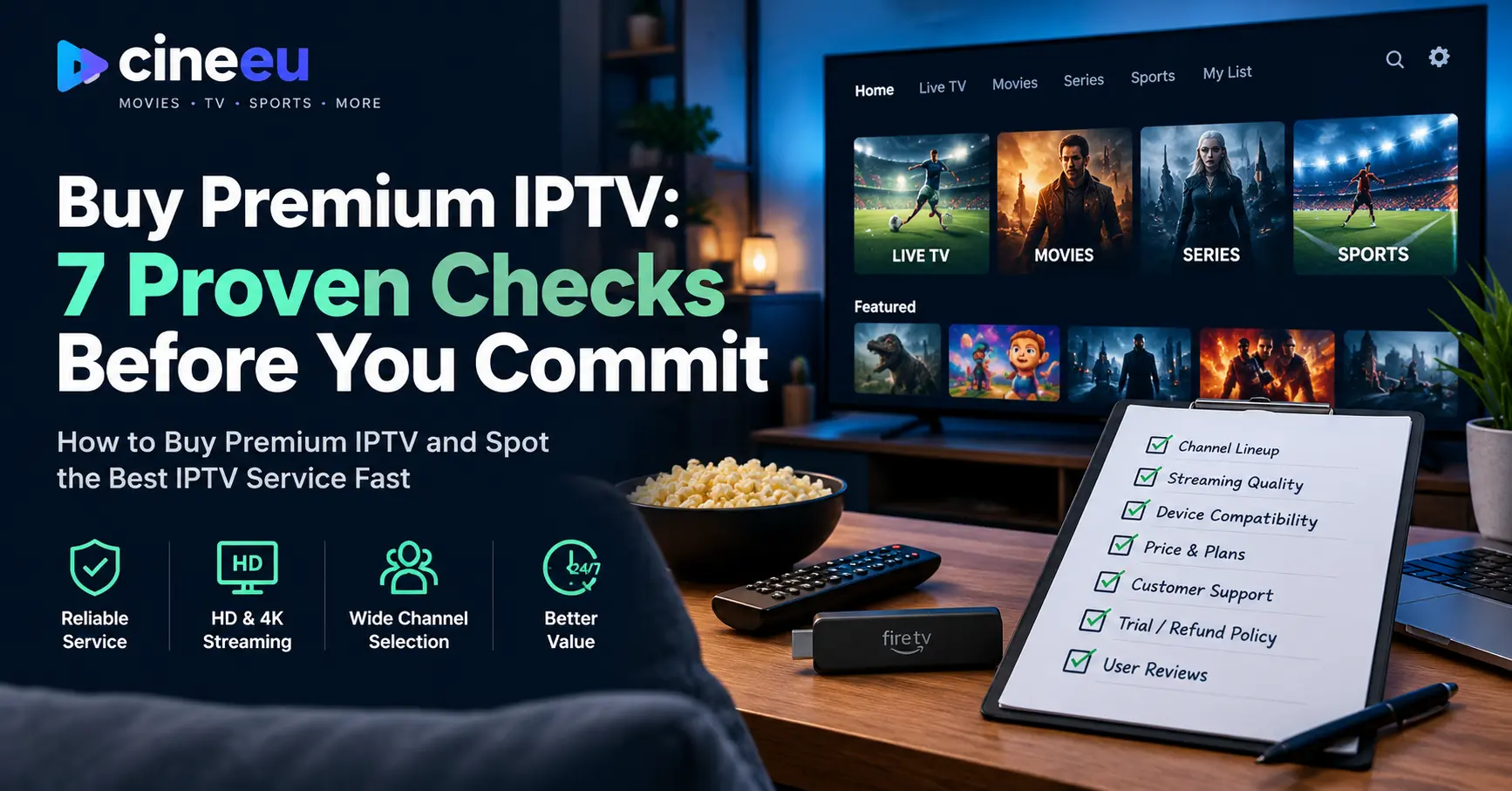
Seven Checks to Run Before You Buy Premium IPTV
These are the seven checks I run every time, roughly in order of importance. None of them needs technical skill.
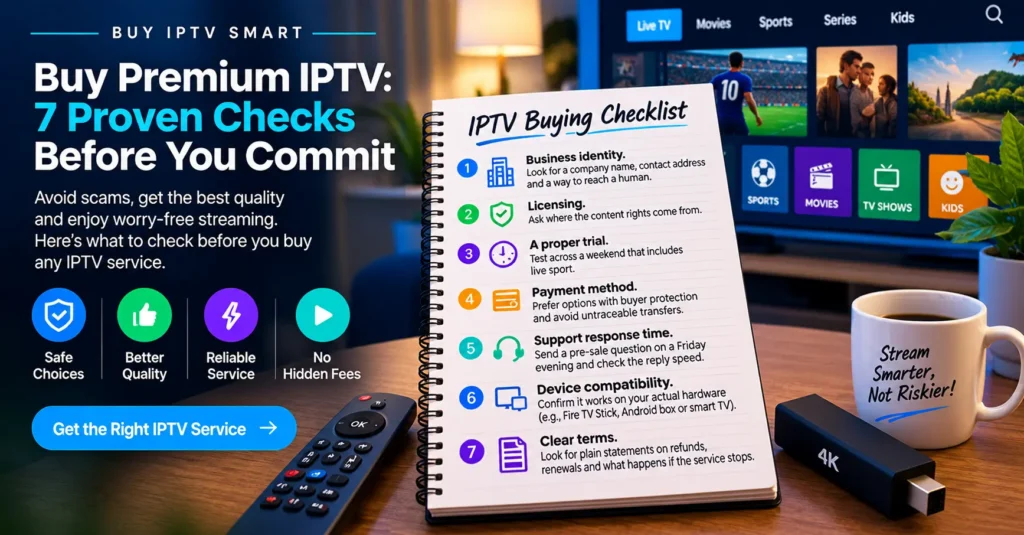
- Business identity. Is there a company name, a contact address and a way to reach a human? If a seller says it’s UK registered, you can search Companies House for free.
- Licensing. Ask where the content rights come from. A confident seller answers clearly, and a nervous one changes the subject.
- A proper trial. Test across a weekend that includes live sport, not a quiet Tuesday morning.
- Payment method. Prefer options with some buyer protection, and be wary of anything that only accepts untraceable transfers.
- Support response time. Send a pre-sale question on a Friday evening and see how long the reply takes.
- Device compatibility. Confirm it works on your actual hardware, whether that’s an Amazon Fire TV Stick, an Android box or a smart TV.
- Clear terms. Look for plain statements on refunds, renewals and what happens if the service stops.
Seven checks might feel excessive, but each one closes a door that careless or dishonest sellers rely on. Skip two or three and you’re gambling. Run all of them and the gamble turns into a decision.
Licensing deserves a closer look because it’s the check people skip most often. It feels awkward to ask, so buyers assume it’s fine. A seller who has nothing to hide will be glad you asked, because it separates them from the crowd.
Trials deserve the same respect. A few hours of testing on a quiet afternoon proves almost nothing, since most services behave well when few people are watching. Push the trial through a Saturday afternoon and you’ll learn what a year would feel like.
Short on time? Make it licensing, the trial and the support test. Those reveal the most for the least effort. And when you buy premium iptv after passing all three, you’ll sleep better.
Price Tables and What They Hide
Prices look simple until you read the small print. Here’s a made-up example of how three typical offers compare, so nobody mistakes it for a quote.
| Offer | Headline price | What’s often missing | Likely real cost |
|---|---|---|---|
| Cheap monthly | £4 | Support, trial, clear terms | £4 plus frustration |
| Mid-range yearly | £60 | Little, if the seller is honest | £60 |
| Premium bundle | £110 | Nothing, but only useful if shared | £110 split across a household |
Reading across, the middle row is where most sensible buyers land. The bundle makes sense only when several people share it. And the cheap option is cheap only until it stops working.
Divide any yearly price by twelve, then ask what you’d pay for a gym membership that was closed half the time. Suddenly the bargain stops looking like one. Anyone ready to buy premium iptv should do that sum first, because it takes thirty seconds and saves a lot of regret.
Bundles deserve a careful look too. Extra connections are useful if two TVs and a tablet share the account, but they add nothing if you live alone. Pay for what you’ll actually use.
Honestly, the best value is rarely at either end of the price list. It sits in the middle, where support exists and the seller still wants your renewal.
Red Flags That Should Make You Walk Away
Warning signs come in two kinds, the loud and the quiet. Learn to spot both.
Loud ones are easy. Sellers who refuse trials, push a yearly plan straight away or demand payment by untraceable transfer are telling you something. So is anyone who answers every question with a discount.
Quieter ones need a sharper eye. Reviews that all use the same phrases, a website with no contact page and a social account created last month deserve a raised eyebrow. None proves anything alone, but three together usually spell trouble.
I once spent an evening comparing a dozen review posts for a single seller. Eleven of them used the same odd phrase about “lightning fast zapping”. Real customers rarely write like a brochure.
What should you do when you spot one? Pause, ask a direct question and watch the reply. Honest sellers answer plainly, while evasive ones give themselves away within a message or two.
Trust your instincts here. If something feels off, there’s usually a reason, and no discount is big enough to justify ignoring it.
Picking the Best IPTV Service for Your Living Room
Ask ten households what the best iptv service looks like and you’ll get ten answers. A football fan wants stable live events. A parent wants a tidy catalogue with child profiles. An expat wants channels from home, with a programme guide that actually matches the schedule.
Test It the Way You’ll Actually Watch
Before settling on the best iptv service for your home, test it on the devices you’ll really use. Try Saturday at three o’clock and Wednesday morning at eleven. Note how fast channels start, how often pictures freeze and whether the guide is accurate. Test first, then buy premium iptv.
Check your own connection too. Fast.com or Speedtest by Ookla will tell you whether the problem is your broadband. In my experience, half of all buffering complaints turn out to be Wi-Fi in the wrong corner of the house.
Apps matter. Players such as TiviMate and IPTV Smarters Pro are widely used, and a service that behaves well in more than one gives you a way out if an app misbehaves.
My One-Line Rule
My rule is simple. The best iptv service is the one that still works on the night you most need it, and everything else is decoration.
The Legal and Consumer Side Nobody Enjoys
Streaming sits in a legal grey area in many people’s minds, and it shouldn’t. In the UK, selling or using unlicensed content can carry real consequences, and organisations such as FACT, the Federation Against Copyright Theft, and Trading Standards actively pursue it.
Because of that, licensing is my second check, not an afterthought. A service that can show where its rights come from protects you as much as it protects them. If a seller won’t answer, treat that as your answer.
Ofcom publishes guidance for UK communications customers, and Citizens Advice explains consumer rights in clear language. Neither is written for streaming buyers specifically. Both will show you what you’re entitled to expect from any paid service.
Keep your own records, too. Save the receipt, the terms and any chat where the seller promised something. If you ever need a refund, evidence is worth more than anger.
Being an editor rather than a solicitor, I’d urge you to speak to one if you’ve a specific legal worry. And when you buy premium iptv from anyone, make sure you’d be comfortable showing the invoice to a stranger.
After the Sale: What Good Support Looks Like
The first week after you buy premium iptv tells you more than any review. Pay attention to how the seller behaves once they’ve got your money.
Good support tends to look like this:
- A welcome message with setup instructions, sent within minutes.
- Named contacts and a reply time you can actually count on.
- Honest notices when maintenance or faults are expected.
- A renewal reminder before expiry, not a cut-off after it.
- A refund policy that’s written down and followed.
Poor support looks like the opposite. Replies arrive in days, answers are vague and every fault is blamed on your router. Sometimes it is your router, of course, but a good seller helps you check.
One small habit helps. Keep a note of every fault with the date and time. After a month you’ll see a pattern, and a pattern is something a decent seller can fix.
Weekly failures mean you should move on. Loyalty to a weak service isn’t a virtue, and your viewing time is worth more than that.
If You’re Thinking of Reselling Yourself
Plenty of readers buy premium iptv as customers first and wonder about selling second. If that’s you, treat everything above as your supplier checklist. A good iptv reseller is simply someone who’s been a careful buyer for long enough to know what customers want.
Be honest about the commitment. You’ll deal with refunds, complaints and late-night faults, and your reputation travels faster than your marketing. Work only with an iptv panel provider that can show proper licensing, and start with a small batch of credits.
For the full operational picture, From Credits to Customers: A Practical IPTV Panel Reseller Playbook covers billing cycles, renewals and customer handling step by step. Another useful read is how to compare IPTV suppliers if you’re still weighing options.
Not everyone should resell, and that’s fine. Many people are happier as well-informed customers. Either way, the habits in this guide still apply.
A Final Thought Before You Pay
Breathe before you press that payment button. Run your seven checks, test on a busy weekend and save the receipt. The seller who passes all of that deserves your money.
Next time someone offers you a year of premium streams for the price of a sandwich, remember Dev and his screenshot. When you buy premium iptv carefully, you’re not being fussy. You’re being the sort of customer that good sellers want.
Slow down, ask awkward questions and trust the service that welcomes them. That’s how you end up with something you’ll actually enjoy watching.
Frequently Asked Questions
Is it safe to buy premium IPTV online?
It can be safe if you do some homework first. Check the seller’s business details, ask about licensing and take a proper trial before you buy premium iptv for a long plan. Pay with a method that offers some buyer protection and keep every receipt. Rushing is where most people lose money.
How do I choose the best IPTV service for my home?
Start with what your household actually watches, then test the service on the devices you own. Run those tests during busy times such as a Saturday afternoon. Check that the programme guide is accurate and that support replies quickly. The steadiest option usually beats the one with the biggest catalogue.
What’s the difference between an IPTV reseller and an IPTV panel provider?
An iptv reseller sells access directly to viewers, takes payment and handles support. An iptv panel provider sits one step behind, supplying the dashboard and credits the reseller uses to create accounts. Both matter, because a weak link at either level eventually reaches you. Ask who’s responsible for fixes when something breaks.
How much should I pay when I buy premium IPTV?
There’s no fixed figure, since prices vary with connections, support and contract length. Divide any yearly price by twelve and ask whether that’s fair for a service that must work every evening. Be cautious of extremely low prices, because they often hide thin support. Start with a month or a trial before committing to a year.
Can I get a refund if the service stops working?
That depends on the seller’s written terms, which is why you should read them before paying. Reputable sellers explain their refund policy clearly and follow it. Keep screenshots, dates and receipts so you’ve got evidence. If you paid through a protected method, contact your payment provider as well.