Book Appointment Now
IPTV vs Cable TV in Europe: A Clear 2026 Comparison
- On
- InIPTV Setup Guide
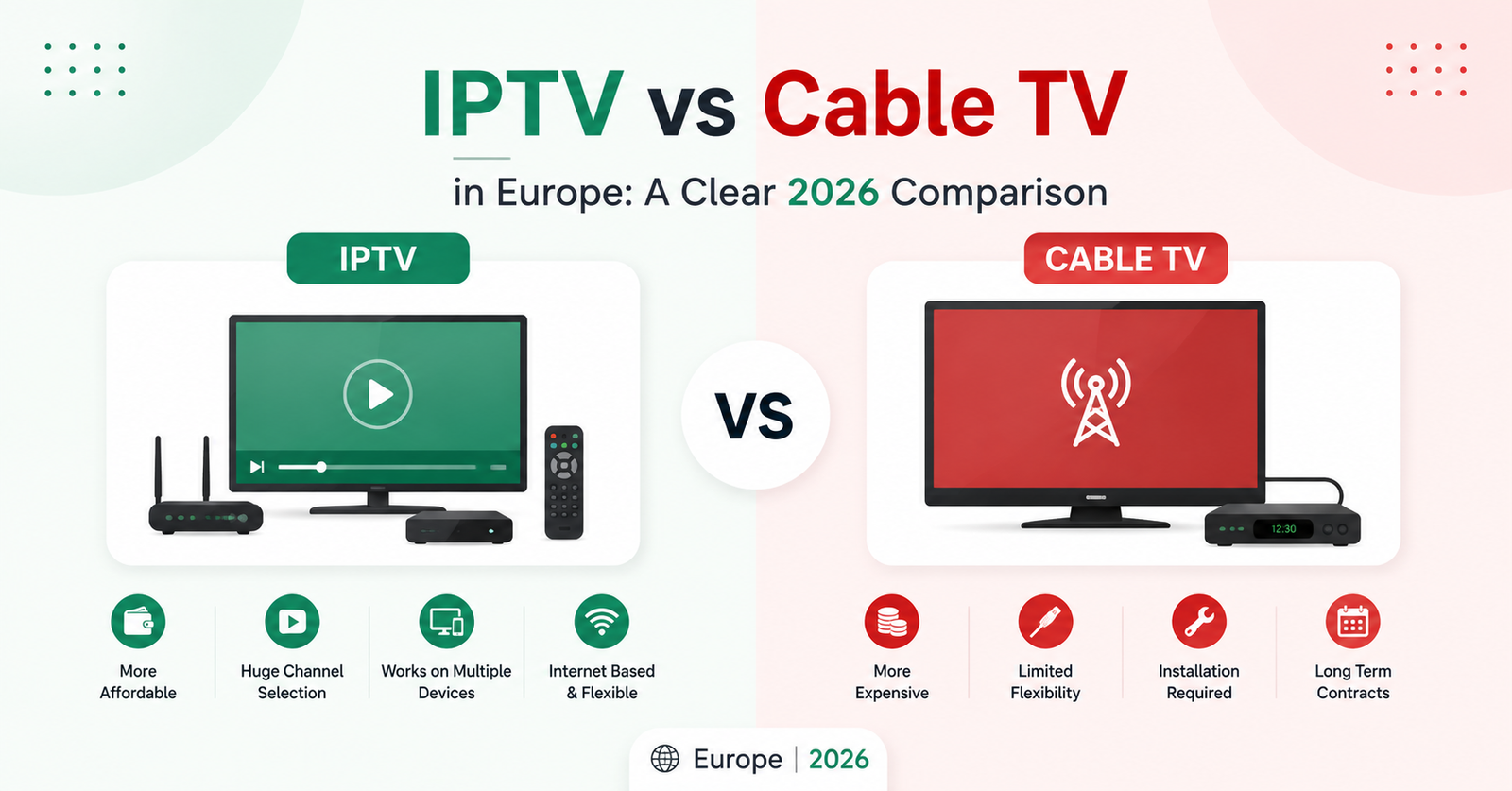
The short answer to IPTV vs Cable TV in Europe is that IPTV usually gives you more flexibility and a lower starting cost, while cable still offers a more predictable connection because it does not depend on your home broadband. IPTV runs over the internet, so your picture quality and reliability are only as good as your line. Cable runs over a dedicated network built by the operator, so it tends to hold steady even when your Wi-Fi is struggling. Neither one is automatically better. The right choice depends on how good your internet actually is, how many devices you need to cover, and whether you want a monthly rolling service or a fixed contract.
[ez-toc]
Why the IPTV vs Cable TV in Europe Question Keeps Coming Up
More households across the Netherlands, Belgium, Germany, France and other parts of Europe are asking this question because streaming habits changed faster than traditional cable contracts did. People want to watch on a phone at work, a tablet in the kitchen, and a television in the living room, often all under one account. Cable was built for a single fixed box in a single room. IPTV was built for exactly this kind of multi device household, which is a big part of why the comparison keeps coming up.
At the same time, broadband quality across Europe has improved enough that streaming a full evening of live sport and box sets no longer feels experimental. That does not mean IPTV is right for everyone. It means the comparison is now genuinely close in a lot of homes, rather than a foregone conclusion either way.
How the Two Actually Work
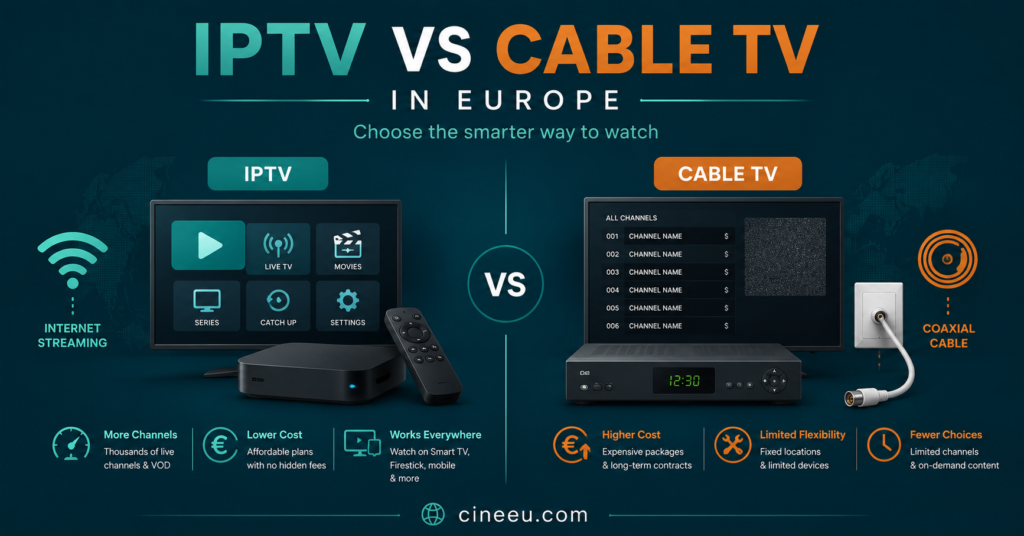
Cable TV sends a signal down a coaxial or fibre line that belongs to the cable operator. That line only carries television, so it is not competing with your video calls, gaming, or downloads. This is why cable has historically felt more stable during peak evening hours.
IPTV sends the same kind of content, live channels, sport, films and series, but delivers it as data over your existing internet connection. Your router, your Wi-Fi signal, and your internet provider’s overall capacity all become part of the chain. A subscription plan from an IPTV provider like Cine EU works well when your home broadband is solid, but the same service will feel inconsistent on a weak or overloaded connection, and that is a limitation of your network rather than the service itself.
The table below lays out the practical differences side by side.
Pro tip: before comparing prices, run a basic speed test on the device you actually plan to watch on, not just your router. A phone on Wi-Fi in a back bedroom often gets a weaker signal than the same router measured from the living room.
Cost and Contracts: The Part Most People Ask About First
Cable pricing in Europe usually bundles television with broadband and sometimes a landline, and it is common for that bundle to sit under a fixed term contract of twelve to twenty four months. Leaving early often means a cancellation charge. The advantage is a known, locked in monthly price for the length of the contract.
IPTV pricing tends to be simpler and shorter term. Most providers, including Cine EU, sell rolling monthly access rather than a long contract, which means you can stop paying whenever you want without a penalty. This suits people who are not certain they will stay long term, or who travel and only need the service for part of the year. It does mean the price is not locked in the same way, so it is worth checking whether a provider’s rates are likely to change.
Neither approach is inherently cheaper once you account for equipment, installation, and how long you actually keep the service, so it is worth working out your own real monthly cost rather than comparing headline prices alone.
Setup and Everyday Use
Cable installation in much of Europe still involves booking an engineer, which can mean a wait of days or weeks depending on the operator and your area. Once installed, the box is usually straightforward, plug in, switch on, done.
IPTV setup happens on devices you likely already own. A setup and onboarding guide from your provider will normally walk you through installing an app on a Firestick, smart TV, Android box, or phone, and most accounts are active within minutes of payment rather than days. The trade off is that you are managing your own equipment and your own internet connection, so if something goes wrong, you need to work out whether the fault sits with your Wi-Fi, your device, or the service itself.
Which One Handles Sport, Live TV and Multiple Screens Better
This is where household habits matter more than the technology itself. If everyone in the house watches from the same room on the same box, cable’s dedicated line removes one variable from the equation. If people in the household want to watch different things on different devices at the same time, IPTV’s app based approach usually adapts more easily, provided the internet connection can genuinely support multiple simultaneous streams.
Live sport is often the toughest real world test for either option, because a slow or overloaded connection shows up immediately during a big match rather than during quiet viewing. This is not a reason to avoid IPTV, but it is a reason to check your connection speed honestly before assuming either option will perform the same way it does in a shop demo or an advert.
A Fair Look at Reliability
Cable has a structural reliability advantage because its signal travels on a private, managed line. That does not mean cable never has faults, but the causes are usually on the operator’s side rather than yours.
IPTV reliability depends on more moving parts, your broadband, your router, your Wi-Fi coverage, and the provider’s own servers. When something goes wrong with an IPTV service, it can be genuinely hard to tell which part of that chain is responsible without some basic troubleshooting. A provider that offers clear, responsive support, reachable through something as simple as WhatsApp rather than a slow ticket system, makes a real difference here, because diagnosing the problem quickly usually matters more than the platform itself.
Pro tip: if a stream buffers repeatedly, restart the router first, then test on a different device before contacting support. This alone resolves a large share of everyday IPTV issues and saves time either way.
Evaluating an IPTV Provider Without the Sales Language
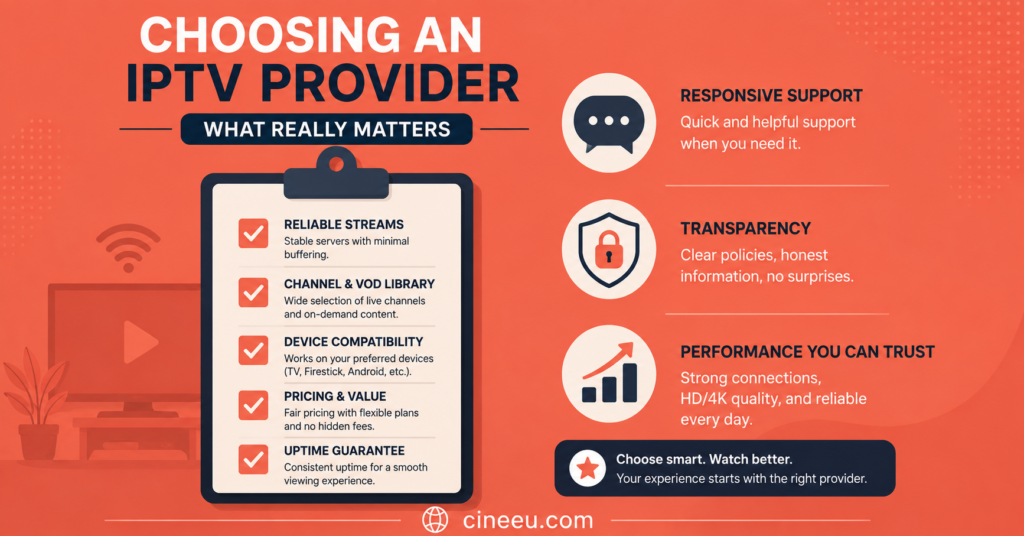
Whichever provider you consider, including an illustrative example like Skip This, the evaluation questions should stay the same. Look past the marketing page and check the practical detail: device compatibility, refund terms, how support actually responds, and whether pricing is presented honestly without vague promises. No provider should be described as guaranteed, licensed, or officially approved without evidence, and that standard applies equally to every name in this space, not just the ones being promoted.
The table below sets out a few direct questions worth asking any provider before you commit to a plan.
Subscriber Guidance
If you are the person actually watching, focus on the things that affect your day to day experience rather than the sales pitch. Check how many devices your account covers, whether the price includes VAT or European taxes clearly, and what the refund window looks like if the service does not suit your setup. A transparent IPTV Reseller page or provider that explains its terms plainly is usually a better sign than one that only shows testimonials and a countdown timer.
Also confirm the provider’s stance on content rights. IPTV itself is simply a delivery method, similar to how a postal service delivers a parcel without being responsible for what is inside it. Whether a specific service is operating on proper licensing and distribution rights depends on the individual provider and the content they carry, and that is worth checking rather than assuming from a professional looking website alone.
Reseller Guidance
For resellers building a business around IPTV rather than cable, the comparison shifts toward operational factors. A reseller dashboard with clear credit balances, straightforward customer account creation, and responsive escalation support matters more day to day than the underlying streaming technology. Cable is not something an individual reseller can offer, since it requires physical network infrastructure, so this comparison is largely academic for anyone building an IPTV panel reseller business rather than a subscriber decision.
Documentation matters here too. Keep a clear record of customer activations, credit purchases, and support conversations, since this protects you if a dispute comes up later and makes it easier to scale the business without losing track of who has what.
When Cable Still Makes More Sense
There are genuine situations where cable remains the steadier choice. If your home broadband is slow, shared across a busy household, or unreliable in the evenings, IPTV will inherit that problem. If you strongly prefer a fixed, unchanging monthly bill and do not mind a longer contract in exchange for that certainty, cable’s structure suits that preference well. And if you only ever watch from one television in one room, IPTV’s flexibility across multiple devices simply will not be something you use.
When IPTV Makes More Sense
IPTV tends to suit households with decent broadband who want to watch across several devices, who prefer not to be locked into a long contract, and who want the option to start, pause, or cancel without penalty. It also suits people who move between countries within Europe, since an internet based service is not tied to a specific regional cable network the way traditional cable is.
Common Mistakes When Comparing the Two
A frequent mistake is comparing headline prices without factoring in contract length, equipment costs, or how many devices each option actually needs to cover the household. Another is assuming a stream buffering issue means the service is unreliable, when the actual cause is often a weak Wi-Fi signal in one specific room. A third mistake is picking a provider based only on price without checking refund terms or how support actually responds when something goes wrong, which matters far more once you are a few weeks into using the service.
Frequently Asked Questions
Is IPTV cheaper than cable TV in Europe?
IPTV subscriptions are often lower priced month to month and do not usually require a long contract, but cable bundles can work out competitively once broadband and landline are included together. It is worth comparing your actual total monthly cost rather than the advertised headline price.
Do I need especially fast internet for IPTV to work well?
You need a stable connection more than an extremely fast one. A steady, uncongested line matters more for smooth streaming than a very high advertised speed that is shared across many devices in the house.
Can I use IPTV across different European countries?
Most IPTV accounts are not tied to one country’s physical network, so the same login can generally be used while travelling within Europe, provided your internet connection at that location is stable.
Is cable TV disappearing in Europe?
No. Cable remains widely available and preferred by households that want a dedicated, non internet dependent connection, particularly where broadband quality is inconsistent.
What should I check before switching from cable to IPTV?
Confirm your home broadband speed and stability, how many devices you need covered, whether the provider offers a free trial, and what the refund and support terms actually say in writing.
Is IPTV legal in Europe?
IPTV is a delivery technology, not a legal status on its own. Legality depends on whether the specific provider holds proper content distribution rights, so it is worth checking a provider’s terms and business transparency before subscribing.
Conclusion
There is no single winner in IPTV vs Cable TV in Europe, only a better fit for your specific household. Cable offers a dedicated line and a fixed contract, which suits people who want certainty and do not mind being tied in. IPTV offers flexibility, shorter commitments, and multi device access, which suits people with solid home broadband who want more control over how and where they watch. The most useful next step is an honest look at your own internet connection and viewing habits before comparing any specific plan or provider, since that single factor decides which option will actually perform the way it promises.
Decision Checklist
- Test your home broadband speed and stability on the actual device you will watch on
- Count how many devices and rooms need coverage at the same time
- Compare total monthly cost, not just the headline price, including any contract length
- Check refund terms and how support is actually reached before paying
- Confirm the provider explains content rights and licensing honestly rather than vaguely
- Decide whether a rolling monthly service or a fixed contract suits your situation better
Newsletter Updates
Enter your email address below and subscribe to our newsletter